Brit in Poland
Home › Culture › Polish expressions
LANGUAGE · CULTURE · A BRIT’S PERSPECTIVE

Polish Expressions That Make Absolutely No Sense in English (Until They Do!)

From bald horses and blue almonds to gingerbread, windmills and spectacularly unfortunate elephants.

56 sayings · 9 themes · 4 November 2026
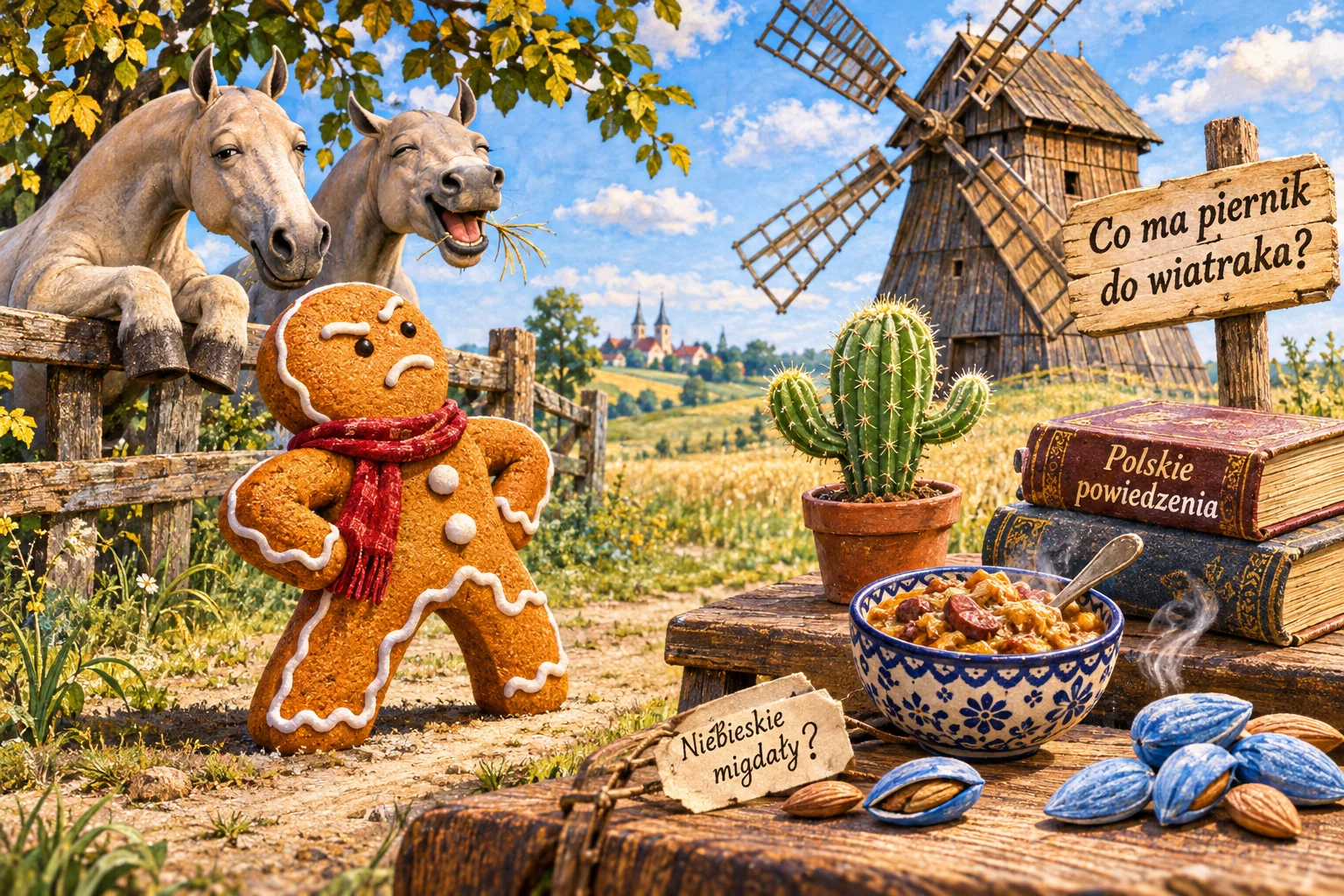
Whimsical Polish countryside illustration: a gingerbread figure confronting a windmill, two horses looking on, a cactus and blue almonds
THE STORY BEHIND THE SAYINGS

A Different Language, A Different Way of Seeing the World

One of the joys of living in another country is discovering that people don’t just speak a different language. Sometimes, they seem to inhabit an entirely different universe of metaphors.

Take Poland, for example. In Britain, when something is easy, we call it a piece of cake. In Poland, it’s bułka z masłem — a bread roll with butter. When someone makes a mountain out of a molehill, Poles can turn a perfectly innocent sewing needle into a pitchfork. And if you’re attempting something wildly unrealistic, you might find yourself attacking the sun with a gardening hoe.

Then there are the bald horses. Apparently, two people who know each other extremely well are like a pair of bald horses. Why bald horses? What happened to their hair?

As a Brit who has made Poland his home, I’ve learned that Polish isn’t simply about vocabulary, grammatical cases or words that appear to contain seventeen consonants. It’s also about how people express humour, frustration, affection, disbelief and everyday absurdities.

Some sayings make immediate sense. Others sound as though they were overheard in a very strange dream. But idioms also preserve pieces of culture: shared experiences, literary and religious imagery, local habits and phrases that may have travelled from one language to another.

And sometimes Polish and English describe the same experience in almost the same words. Both languages know what it means to play with fire, have your head in the clouds or break somebody’s heart. Other times we choose different animals: an English person buys a pig in a poke, while a Polish person buys a cat in a sack. Different animals. Same unfortunate shopping experience.

So let’s travel through nine collections of Polish expressions, from kitchen disasters and impossible undertakings to ancient-sounding wisdom and surprising similarities with English. No Polish exam required. The bald horses have agreed to supervise.

CHAPTER 01 / 09

Food for thought

Polish expressions you can almost eat

Illustration introducing food for thought

Bułka z masłem

Literally
“A bread roll with butter”
In English
“A piece of cake”

A comforting snack becomes a shorthand for something straightforward. A British cake and a Polish buttered roll agree on the difficulty level.

Musztarda po obiedzie

Literally
“Mustard after dinner”
In English
“Shutting the stable door after the horse has bolted”

The mustard has arrived after everyone has finished eating. It may be perfectly good mustard, but its moment has passed.

Nudne jak flaki z olejem

Literally
“As boring as tripe with oil”
In English
“As dull as watching paint dry”

A formidable insult to both entertainment and a traditional ingredient. You need not dislike flaki to appreciate the metaphor.

Iść jak po maśle

Literally
“To go as if across butter”
In English
“To go like clockwork / go smoothly”

Rather than eating the butter, this time you glide over it. The phrase describes a task proceeding without obstacles.

CHAPTER 02 / 09

The Polish animal kingdom

Where the wildlife has opinions

Illustration introducing the polish animal kingdom

Nie mój cyrk, nie moje małpy

Literally
“Not my circus, not my monkeys”
In English
“Not my problem”

A superb way to decline ownership of somebody else’s chaos. It has travelled into English too, so it may already sound familiar.

Kupić kota w worku

Literally
“To buy a cat in a sack”
In English
“To buy a pig in a poke”

The British buyer acquires a pig; the Polish buyer gets a cat. Neither has inspected the goods and both may regret it.

Nie wywołuj wilka z lasu

Literally
“Don’t call the wolf out of the forest”
In English
“Don’t tempt fate”

Why summon trouble when it is behaving perfectly well somewhere else?

Mieć węża w kieszeni

Literally
“To have a snake in your pocket”
In English
“To be tight-fisted”

The pocket snake appears to defend your money against all attempts to spend it.

Patrzeć jak sroka w gnat

Literally
“To stare like a magpie at a bone”
In English
“To stare fixedly / gape at something”

A vivid image of intense attention, sometimes with a suggestion of helpless fascination.

CHAPTER 03 / 09

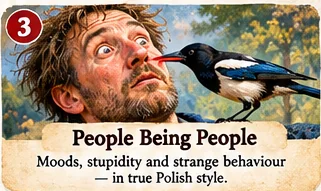
People being people

Moods, mishaps and peculiar personalities

Illustration introducing people being people

Mieć muchy w nosie

Literally
“To have flies in your nose”
In English
“To be in a foul mood”

When somebody is unusually grumpy, the Poles apparently suspect an insect infestation.

Robić z igły widły

Literally
“To make a pitchfork from a needle”
In English
“To make a mountain out of a molehill”

An impressive feat of unnecessary manufacturing: turning a tiny concern into a giant crisis.

Jak grochem o ścianę

Literally
“Like throwing peas at a wall”
In English
“Like talking to a brick wall”

You explain something repeatedly; the listener remains unmoved. The peas, meanwhile, accomplish very little.

Wiercić komuś dziurę w brzuchu

Literally
“To drill a hole in somebody’s belly”
In English
“To nag someone relentlessly”

For the record, nobody is meant to produce an actual drill. This is pressure through endless questions or requests.

Mieć dwie lewe ręce

Literally
“To have two left hands”
In English
“To be all thumbs”

A familiar verdict on someone who is hopeless at practical jobs.

CHAPTER 04 / 09

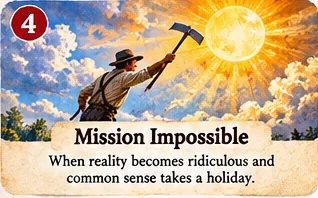
Mission impossible

When common sense takes a holiday

Illustration introducing mission impossible

Obiecywać gruszki na wierzbie

Literally
“To promise pears on a willow tree”
In English
“To promise the moon”

The fruit is lovely, but the tree is wrong. An ideal description of grand promises that cannot be delivered.

Raz na ruski rok

Literally
“Once in a Russian year”
In English
“Once in a blue moon”

An informal saying for something that happens very rarely; its wording is culturally specific rather than a factual statement about calendars.

Szukać igły w stogu siana

Literally
“To look for a needle in a haystack”
In English
“To look for a needle in a haystack”

A near-perfect match with English. Consider this a preview of our final category.

Złapać Pana Boga za nogi

Literally
“To grab God by the legs”
In English
“To hit the jackpot / think you’ve struck lucky”

Usually about getting an exceptionally good opportunity, sometimes with an ironic hint that somebody is too pleased with themselves.

CHAPTER 05 / 09

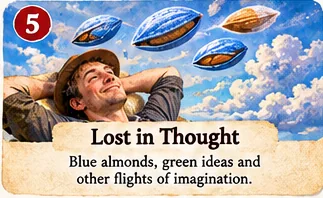
Lost in thought

Blue almonds and other mental adventures

Illustration introducing lost in thought

Nie mieć zielonego pojęcia

Literally
“Not to have a green idea”
In English
“Not to have the faintest idea”

For reasons that have little to do with gardening, the absent idea is specifically green.

Ni z gruszki, ni z pietruszki

Literally
“Neither from a pear nor from parsley”
In English
“Out of the blue”

A wonderfully mismatched fruit-and-vegetable introduction to something that happens unexpectedly or without apparent connection.

Robić komuś wodę z mózgu

Literally
“To make water out of someone’s brain”
In English
“To mess with somebody’s head”

To confuse, manipulate or overwhelm a person with misleading talk.

Mieć klapki na oczach

Literally
“To have blinkers over your eyes”
In English
“To have blinkers on”

A metaphor for refusing to see beyond a narrow view of things, familiar to English speakers too.

CHAPTER 06 / 09

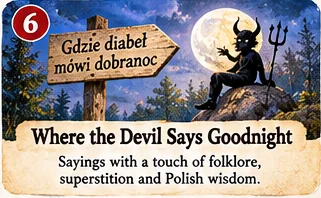
Where the devil says goodnight

Folklore, fear and a hint of superstition

Illustration introducing where the devil says goodnight

Gdzie diabeł mówi dobranoc

Literally
“Where the devil says goodnight”
In English
“In the middle of nowhere”

Somewhere so remote that even the devil apparently calls it a night.

Nie taki diabeł straszny, jak go malują

Literally
“The devil isn’t as frightening as they paint him”
In English
“It’s not as bad as it looks”

A reassuring proverb that reminds us how much our imaginations can inflate a problem.

Pal sześć!

Literally
“Let six burn! (literal words; origin uncertain)”
In English
“Oh, forget it! / never mind!”

A compact expression of resignation or dismissal. Its word-for-word reading is not a reliable explanation of its origin.

Odpukać w niemalowane

Literally
“To knock on unpainted wood”
In English
“Touch wood”

Say it before fortune notices that things have been going rather well.

Strach ma wielkie oczy

Literally
“Fear has big eyes”
In English
“Fear makes things seem worse”

An elegant image for the way anxiety can magnify a threat.

CHAPTER 07 / 09

When things go spectacularly wrong

Life refuses to follow the plan

Illustration introducing when things go spectacularly wrong

Wyjść jak pies na jeżu

Literally
“To come out like a dog on a hedgehog”
In English
“To get the worst of the bargain”

Neither the dog nor the person comes away from the encounter feeling especially triumphant.

Wpaść z deszczu pod rynnę

Literally
“To fall from the rain under a gutter”
In English
“Out of the frying pan into the fire”

Escaping one unpleasant situation only to land in a worse one.

Mieć nóż na gardle

Literally
“To have a knife at your throat”
In English
“To be under extreme pressure”

A vivid expression for deadlines, financial pressure or lack of room to manoeuvre.

Rzucać słowa na wiatr

Literally
“To throw words to the wind”
In English
“To make empty promises / talk into the wind”

Words disappear into the breeze rather than becoming action.

CHAPTER 08 / 09

A little Polish wisdom

Experience, caution and the occasional kitchen

Illustration introducing a little polish wisdom

Co nagle, to po diable

Literally
“What is rushed belongs to the devil”
In English
“More haste, less speed”

A warning that rushing often makes things worse. The devil has apparently acquired another responsibility.

Mądry Polak po szkodzie

Literally
“A Pole is wise after the damage”
In English
“Wise after the event”

Self-deprecating national wisdom about learning a lesson a little too late.

Nie chwal dnia przed zachodem słońca

Literally
“Don’t praise the day before sunset”
In English
“Don’t count your chickens before they hatch”

Avoid celebrating before you know how things turn out.

Gdzie kucharek sześć, tam nie ma co jeść

Literally
“Where there are six cooks, there is nothing to eat”
In English
“Too many cooks spoil the broth”

A remarkably close match in meaning and kitchen imagery, though the Polish version is more dramatic about the lack of dinner.

Apetyt rośnie w miarę jedzenia

Literally
“Appetite grows as you eat”
In English
“The more you have, the more you want”

Originally culinary in imagery, widely useful for growing ambition and desire.

CHAPTER 09 / 09

Different languages, same ideas

When Polish and English unexpectedly agree

Illustration introducing different languages, same ideas

Mieć głowę w chmurach

Literally
“To have your head in the clouds”
In English
“To have your head in the clouds”

The same sky, the same daydreamer.

Diabeł tkwi w szczegółach

Literally
“The devil is in the details”
In English
“The devil is in the details”

The difficulty hides in the finer points; a strikingly close verbal match.

Dolewać oliwy do ognia

Literally
“To pour oil onto the fire”
In English
“To add fuel to the fire”

Even the incendiary metaphor is shared. The Polish fuel just happens to be oil.

Igrać z ogniem

Literally
“To play with fire”
In English
“To play with fire”

The warning survives translation almost untouched.

Krok po kroku

Literally
“Step by step”
In English
“Step by step”

Sometimes no elaborate metaphor is required.

Łamać komuś serce

Literally
“To break somebody’s heart”
In English
“To break somebody’s heart”

The emotional image crosses the language barrier perfectly.

Cisza przed burzą

Literally
“The calm before the storm”
In English
“The calm before the storm”

Weather offers both languages the same warning of trouble ahead.

Nie wszystko złoto, co się świeci

Literally
“Not everything that shines is gold”
In English
“All that glitters is not gold”

The familiar warning against judging by appearances.

Wstać lewą nogą

Literally
“To get up with the left leg”
In English
“To get out of bed on the wrong side”

Both cultures blame the morning for a bad mood, with slightly different anatomy.

Budować zamki na piasku

Literally
“To build castles on sand”
In English
“To build on sand”

An image of plans built on an unreliable foundation, associated with a wider European and biblical tradition.

Different images. Remarkably familiar people.

Why do we sometimes land on the same metaphor, yet other times need completely different animals, ingredients or celestial gardening equipment? Some similarities come from shared European stories and religious traditions; some from phrases borrowed over centuries of contact; and others may reflect familiar human experiences. Similarity alone cannot tell us which explanation is right — but it gives us a wonderful question to explore.

That may be my favourite discovery about learning Polish: the language can seem wonderfully strange at first, yet it regularly reveals how much we have in common. And the next time someone tells me that work isn’t a hare, I shall be happy to make another coffee.

Know an expression we missed?

Polish readers, tell us your favourite saying — especially one that sounds completely ridiculous in English. Share it in the Brit in Poland community. The committee of bald horses welcomes corrections.