
From Robbo to The Witcher: How Poland Became a Gaming Powerhouse
The story starts before Geralt
In Poland, the history of video games is often told backwards: first comes a white-haired monster hunter, then a sprawling science-fiction metropolis, and only then the people who built the industry. It makes an exciting introduction, but misses an equally remarkable story.
Polish game makers were experimenting with computers decades before CD Projekt RED existed. In the 1980s, writers and programmers tried creating games for machines that were expensive, scarce and difficult to distribute. In the 1990s, small teams learned to sell their work to a newly opening market. Some of those teams disappeared. Others grew, changed names or helped train a generation of developers. Later, Polish studios succeeded not only with big-budget role-playing adventures but also with shooters, survival games, horror, strategy titles and simulations.
The story is not a miracle caused by technological shortages. The restrictions of socialist-era Poland shaped the early hobby scene, but the industry's later rise depended on entrepreneurship, education, international publishing, access to finance and digital distribution. Games were an art form and a business — and Poland had to learn both.
Games before an industry: the 1960s to the 1980s
Among the earliest documented Polish experiments was a game of noughts and crosses associated with programmer Bogdan Miś and the Warsaw-developed XYZ computer around 1960. In Wrocław, Witold Podgórski created Marienbad, a version of the mathematical game Nim, for the Odra 1003 in the early 1960s. Its results appeared through a machine interface rather than anything like a modern screen. These were computer games, but not consumer products or commercial videogame releases.
The distinction matters. There is no universally accepted “first Polish video game” unless we agree whether we mean a university experiment, a screen-based game, a commercial release or a title sold beyond Poland. The history is richer when we preserve those distinctions.
In the 1980s, Polish creators began making software for home computers. Marcin Borkowski's Puszka Pandory (1986), a text-based post-apocalyptic adventure for ZX Spectrum, became an important early example. It was sold in the informal computer-market environment, where copying could spread a game and undermine its creator's income almost immediately. Borkowski later became associated with pioneering games journalism. Other early developers pursued adventure games, experiments and ambitious projects with little infrastructure to support them.
Featured story — A game and its own reviewer: A retrospective account suggests Borkowski reviewed Puszka Pandory under a pseudonym. This anecdote is entertaining but should be held for the final version until the original magazine review is checked.
Robbo, Blockout and the first success stories
In 1989, two titles showed different futures for Polish development. Janusz Pelc's Robbo, associated with LK Avalon in the Rzeszów area, became a widely remembered eight-bit puzzle game. Players guided a small robot through increasingly difficult levels, collecting items while avoiding hazards. It demonstrated that a Polish-developed game could build a local audience and an enduring reputation.
Blockout, associated with Polish programmers Aleksander Ustaszewski and Mirosław Zabłocki, took the familiar idea of falling blocks into three dimensions. Distributed internationally, it showed another possibility: Polish-developed software could reach players abroad, even if its publisher was not Polish.
The distinction between developer and publisher becomes crucial here. The team that designs and builds a game is not necessarily the business that markets it, distributes it or owns its brand. In this catalogue, “made in Poland” means substantial Polish development, not merely a Polish-language edition or a game set in Poland.
Building studios in a changing economy
After 1989, the market for games changed quickly. The collapse of old economic barriers did not instantly create successful development studios, but it brought new ways to trade, publish and work with foreign partners. Companies learned business skills through software distribution and localisation before, or alongside, creating their own games.
Metropolis Software produced memorable adventures including Tajemnica Statuetki and Teenagent. LK Avalon continued publishing Polish games. Polanie explored a Slavic-inspired setting through real-time strategy, while Earth 2140 and later Gorky 17 showed growing technical and design ambition. Other studios experimented with shooters, fantasy worlds and platform games. This was not one continuous ascent: many games found small audiences, and some companies did not survive.
Techland's roots lay in software trading and publishing before original development became central to its business. CD Projekt began as a distributor and developed a reputation for ambitious Polish-language editions of international games, including Baldur's Gate in 1999. Later, CD Projekt RED would create The Witcher. The path from market stalls to international success was real for some founders — but it should not be mistaken for the experience of the entire industry.
The breakthrough years: shooters, westerns and a Witcher
The 2000s brought titles that could compete internationally. People Can Fly's Painkiller (2004) offered fast, spectacular first-person action. Techland's Call of Juarez (2006) brought a Polish-developed western shooter to international players. And in 2007, CD Projekt RED released The Witcher, a role-playing game adapted from the fictional universe of Polish author Andrzej Sapkowski.
Geralt's world would become one of Poland's best-known cultural exports. The Witcher 2 expanded the series' reach, while The Witcher 3: Wild Hunt (2015) made the franchise internationally iconic. The games draw from Sapkowski's writing, which itself combines folklore, history, political imagination and the author's own inventions. Their monsters should never be presented as a direct encyclopaedia of traditional Slavic belief.
This makes a natural bridge to our Polish folklore collection: a later feature can examine how creatures such as the strzyga, południca and leszy change when folklore becomes fantasy literature and then interactive fiction.
Featured story — The Witcher before CD Projekt RED: Metropolis explored a Witcher-related game project before the famous series. Treat this as a research sidebar once the rights history and project chronology have been independently documented.
A wider industry than one famous studio
The 2010s demonstrated how many different kinds of Polish games could travel. Techland made Dead Island and Dying Light, while People Can Fly continued its action-game work. The Astronauts released the atmospheric The Vanishing of Ethan Carter. SUPERHOT reimagined a shooter by making time move only when the player moved. Bloober Team developed a reputation for psychological horror. Red Dot Games, Empyrean, PlayWay and other businesses helped make simulations a commercially significant field, though their roles must not be confused.
Some of the most distinctive international successes came from developers asking uncomfortable questions. In This War of Mine (2014), Warsaw-based 11 bit studios placed players in the position of civilians trying to survive an urban conflict. Rather than celebrating battlefield heroics, the game asks what hunger, fear and scarcity do to ordinary people. It has a clear resonance with Polish memory of war, but it should not be described simply as a game about the Warsaw Uprising. Poland later made the game available as an educational resource, accompanied by teaching materials.
The same studio's Frostpunk (2018) imagined a frozen society where the player must balance survival and morality. Polish-made games were now becoming recognisable not only by budget or polish but by inventive systems and difficult choices.
Modern Poland: many genres, many centres
By the 2020s, Polish development stretched well beyond any one city or genre. Cyberpunk 2077 demonstrated the scale of CD Projekt RED's ambition. The Thaumaturge used an alternative-history 1905 Warsaw as its setting. Hellish Quart turned early modern swordsmanship into a distinctive combat game. Manor Lords brought medieval strategy to a vast international audience through a small Polish-led project. The Alters explored identity and alternative life choices, while Frostpunk 2 returned to the dilemmas of survival and governance.
There is regional depth behind those titles: Warsaw, Wrocław, Kraków, Katowice, Gliwice, Bielsko-Biała, Rzeszów, Szczecin and other places all contribute talent and companies. Some developers work with foreign publishers; others make games for global PC storefronts; still others specialise in mobile games, contracted services, testing or artistic production.
According to the Polish Agency for Enterprise Development's 2025 industry report, the sector comprised 824 studios and publishers and 14,568 specialists. The same report says around 97% of games developed in Poland reach global markets. These are reported industry estimates for 2025, not timeless figures. They illustrate scale, but the sector also faces difficult financing conditions, uneven commercial results and the risk that ambitious projects may not recoup their budgets.
When a game tells a Polish story
Not every Polish-made game is recognisably Polish in its setting. That is a strength, not a weakness: Polish developers make westerns, science fiction, horror, simulations, fantasy and historical strategy for international audiences. But some games invite especially rich connections with Poland's cultural heritage.
Smok Wawelski and Polanie draw on legendary or Slavic motifs. The Thaumaturge imagines Warsaw under Russian rule in 1905. Hellish Quart evokes the world of historical European swordsmanship, including the Polish–Lithuanian Commonwealth. This War of Mine explores civilian vulnerability, a theme that resonates with Polish historical experience. These works do not replace history or folklore scholarship; they provide creative routes into it.
For visitors interested in the places behind the stories, our Warsaw and regional guides offer a different kind of exploration. The city streets of The Thaumaturge are imagined rather than documentary reconstructions, while the landscapes and myths of The Witcher combine several traditions. Comparing fiction with real history is part of the fun.
The next level
Poland's game industry grew from a scattered set of experiments into a diverse international creative sector. Its history includes home programmers and trade stalls, failed businesses and surprising innovations, global publishers and fiercely independent teams. The achievement is not simply producing a few blockbusters. It is building an ecosystem in which a small strategy game, a deeply unsettling war story and an enormous fantasy adventure can all find an international audience.
Below is a curated catalogue of 40 milestones and notable games. It is deliberately selective, not an exhaustive ranking. Dates refer to an original release or significant milestone; a series may be grouped when its contribution is best understood together. A Polish-developed game may have a foreign publisher, while a Polish-themed game made abroad does not qualify solely because of its setting.
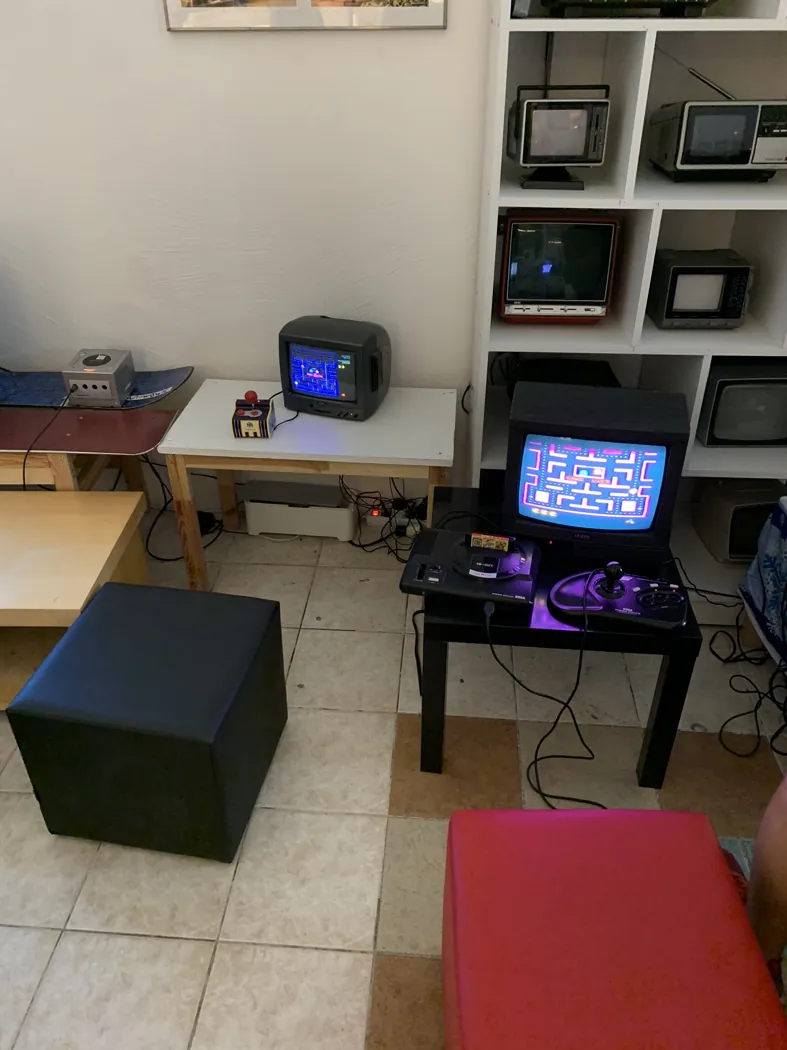
An interactive retro-computing collection in Wrocław. Original photography: A Brit in Poland.
40 Polish gaming milestones
Filter by period or cultural connection. A selective catalogue rather than a ranking; disputed credits remain clearly marked.
Marienbad
Witold Podgórski
Early Polish computer game on Odra 1003
Logic experiment Details under reviewPuszka Pandory
Marcin Borkowski
Formative Polish home-computer adventure
Text adventureSmok Wawelski
To verify
Early game connected to Kraków legend
Text adventure Details under reviewRobbo
Janusz Pelc / LK Avalon
Iconic Polish eight-bit hit
PuzzleBlockout
Polish programmers / P.Z. Karen
Internationally distributed 3D falling-block game
Puzzle Details under reviewElectro Body
xLand
Early Polish PC platformer
Platform Details under reviewHans Kloss
To verify
Popular Polish TV espionage character in games
Action Details under reviewTajemnica Statuetki
Metropolis Software
Landmark Polish point-and-click adventure
AdventureFranco: The Crazy Revenge
To verify
Unusual Polish street-fighting title with Szczecin setting
Beat em up Details under reviewTeenagent
Metropolis Software
Much-loved Polish adventure
AdventurePolanie
To verify
Slavic-flavoured Polish strategy milestone
Real-time strategy Details under reviewEarth 2140
Reality Pump / TopWare
Internationally visible Polish strategy development
Strategy Details under reviewKsiążę i Tchórz
Metropolis Software
Polish fantasy adventure favourite
Adventure Details under reviewGorky 17
Metropolis Software
International tactical RPG visibility
Turn-based tacticsMortyr
To verify
Notable early Polish historical-fiction FPS
First-person shooter Details under reviewKao the Kangaroo
Tate Interactive
International family-friendly game franchise
PlatformChrome
Techland
Ambitious Techland sci-fi FPS
First-person shooterPainkiller
People Can Fly
Polish action-game breakthrough
First-person shooterCall of Juarez
Techland
Western shooter international breakthrough
First-person shooterThe Witcher
CD Projekt RED
Sapkowski universe enters international games
Role-playing gameTwo Worlds
Reality Pump
International fantasy RPG series
Role-playing game Details under reviewThe Witcher 2: Assassins of Kings
CD Projekt RED
Major step in franchise development
Role-playing gameDead Island
Techland
International zombie-game success
Survival actionBulletstorm
People Can Fly / Epic Games
Distinctive action title and international collaboration
First-person shooterThis War of Mine
11 bit studios
Anti-war civilian experience adopted for Polish education
SurvivalThe Vanishing of Ethan Carter
The Astronauts
Atmospheric critically recognised narrative game
AdventureThe Witcher 3: Wild Hunt
CD Projekt RED
Major global cultural export
Role-playing gameDying Light
Techland
Parkour and open-world zombie hit
Survival actionSUPERHOT
SUPERHOT Team
Distinctive time-moves-with-player mechanic
Action puzzleDarkwood
Acid Wizard Studio
Influential independent survival horror
HorrorFrostpunk
11 bit studios
Ethical and political survival strategy
City-building survivalHouse Flipper
Empyrean
Accessible renovation simulator and commercial success
SimulationGreen Hell
Creepy Jar
Survival simulation set in Amazon rainforest
SurvivalCyberpunk 2077
CD Projekt RED
Ambitious international science-fiction release
Role-playing gameGhostrunner
One More Level
Stylish cyberpunk parkour action game
ActionHellish Quart
Kubold
Historical fencing linked to Commonwealth-era culture
Sword-fighting simulationAgainst the Storm
Eremite Games
Distinctive roguelite city-builder
StrategyThe Thaumaturge
Fool's Theory
Supernatural reimagining of Warsaw in 1905
Role-playing gameManor Lords
Slavic Magic
International breakout of small Polish-led project
StrategyThe Alters
11 bit studios
Ambitious identity-driven science-fiction game
Narrative strategyOfficial game galleries & source material
For contemporary game artwork, use the publishers’ official galleries. These are linked rather than copied without clear redistribution permission.
Historical references: PARP 2025 industry report · Culture.pl: Polish adventure games · 40 years of Polish gamedev exhibition.