
1. From Balkan horsemen to Commonwealth elite
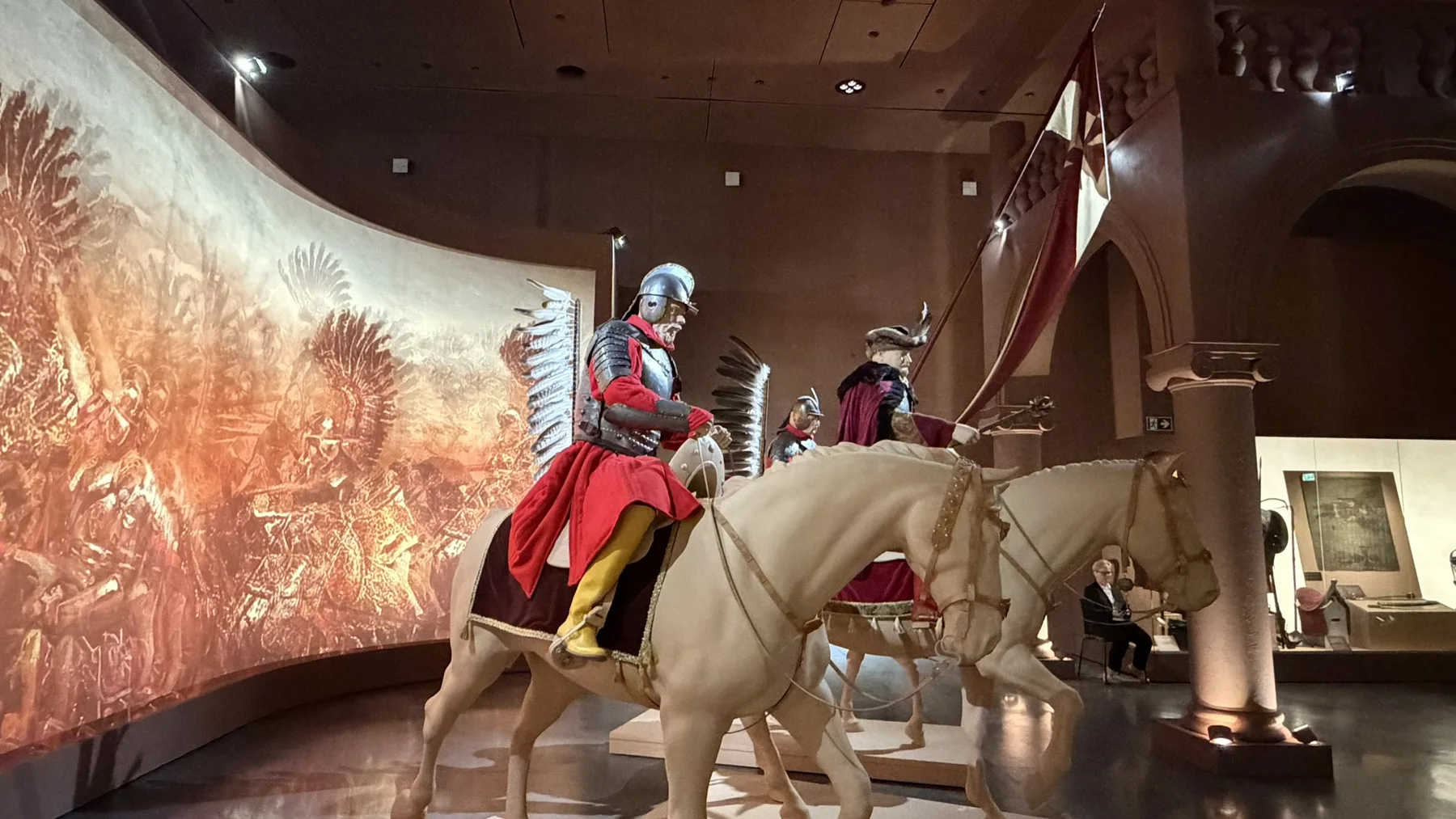
Despite becoming inseparable from Polish national identity, the origins of the winged hussars lie considerably further south. Early hussars emerged from military traditions of the Balkans and Hungary, shaped by conflict along the Ottoman frontier. Serbian and Hungarian horsemen entered Polish service around the beginning of the sixteenth century. Relatively lightly equipped, they carried lances and distinctive shields and relied on mobility.
Their transformation into armoured shock cavalry was gradual. Under Stefan Batory, king of Poland and grand duke of Lithuania from 1576 to 1586, military reforms helped standardise equipment and organisation. Shields gradually disappeared, armour became increasingly important and the long lance became central to their battlefield role.
By the late sixteenth century the Commonwealth’s husaria was distinct from the light cavalry later known elsewhere in Europe as hussars. The formation inherited knightly ideas of honour and prestige, but belonged to the early modern world of paid military service, gunpowder and organised armies. Not every hussar was a nobleman. Both the Crown and Grand Duchy of Lithuania fielded their own hussar units.
2. Becoming a hussar
The magnificent horses and impressive armour concealed an extraordinary financial burden. A hussar banner, or chorągiew, was raised under a military commission by a rotmistrz. Within it, companions (towarzysze), generally noblemen, equipped themselves and a small retinue of fighting men. The companion and his retainers formed a poczet. Retainers, or pocztowi, could be poorer nobles or men from other backgrounds; servants and horse handlers supported the formation on campaign.
Illustrative organisation; the size of each retinue varied over time.
A suitable war horse could cost many times a rider’s annual military pay. The companion also had to provide equipment for his retainers, additional mounts, transport and supplies. Horses lost to disease, injury or combat had to be replaced; pay could arrive late. Service could consume a family’s wealth rather than increase it.
Why undertake such an expensive occupation? Honour, political influence, family tradition and social recognition all mattered. The military system relied heavily on private wealth and personal commitment. Behind the feathers stood a network of men whose contributions are often overlooked.
3. Anatomy of a hussar
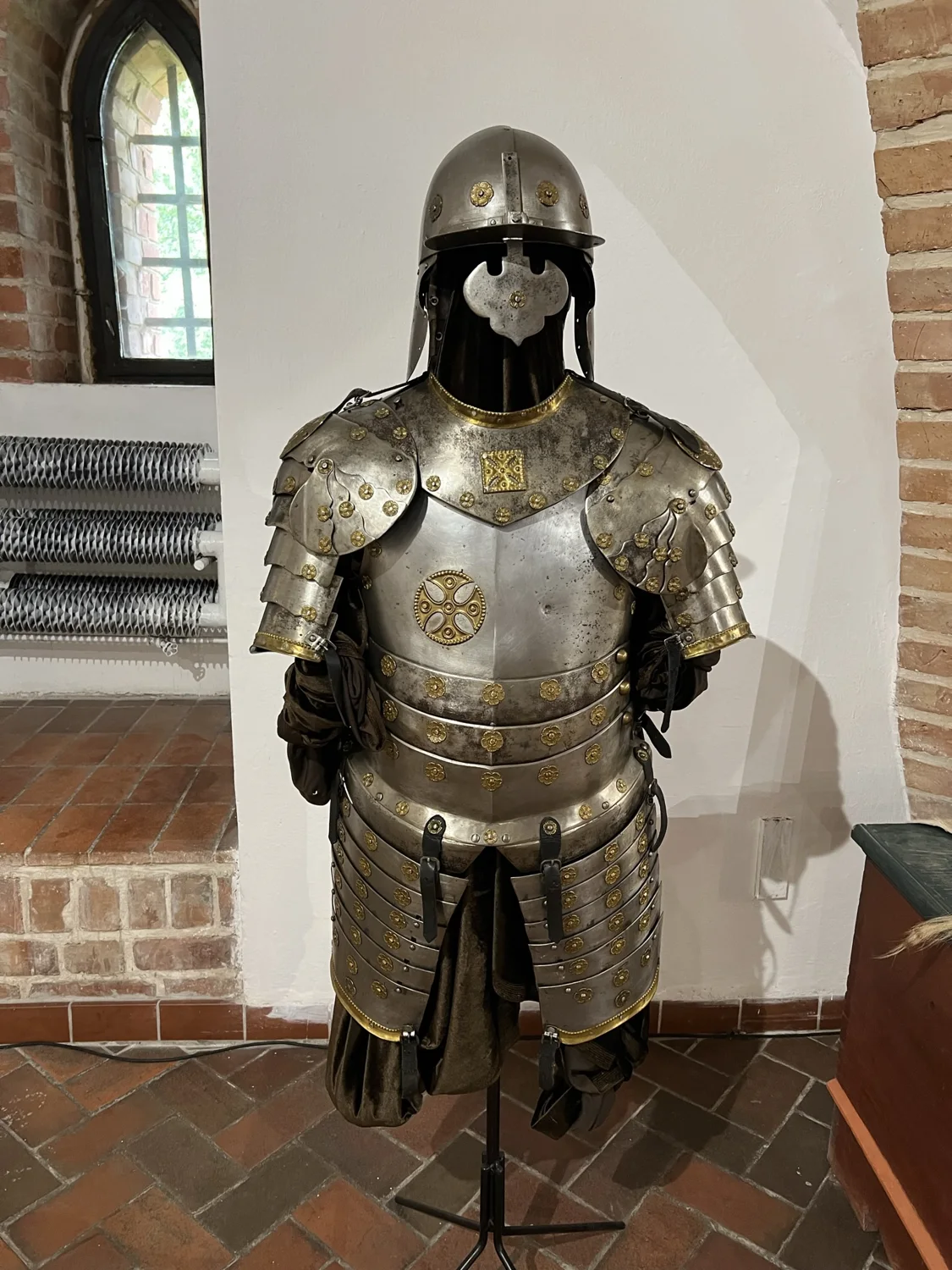
Hussar equipment brought together European metalworking and Eastern influences. Typical seventeenth-century armour concentrated protection on the head, torso and arms, rather than enclosing the entire body in plate. Brass fittings and religious motifs could make functional protection a statement of wealth and identity.
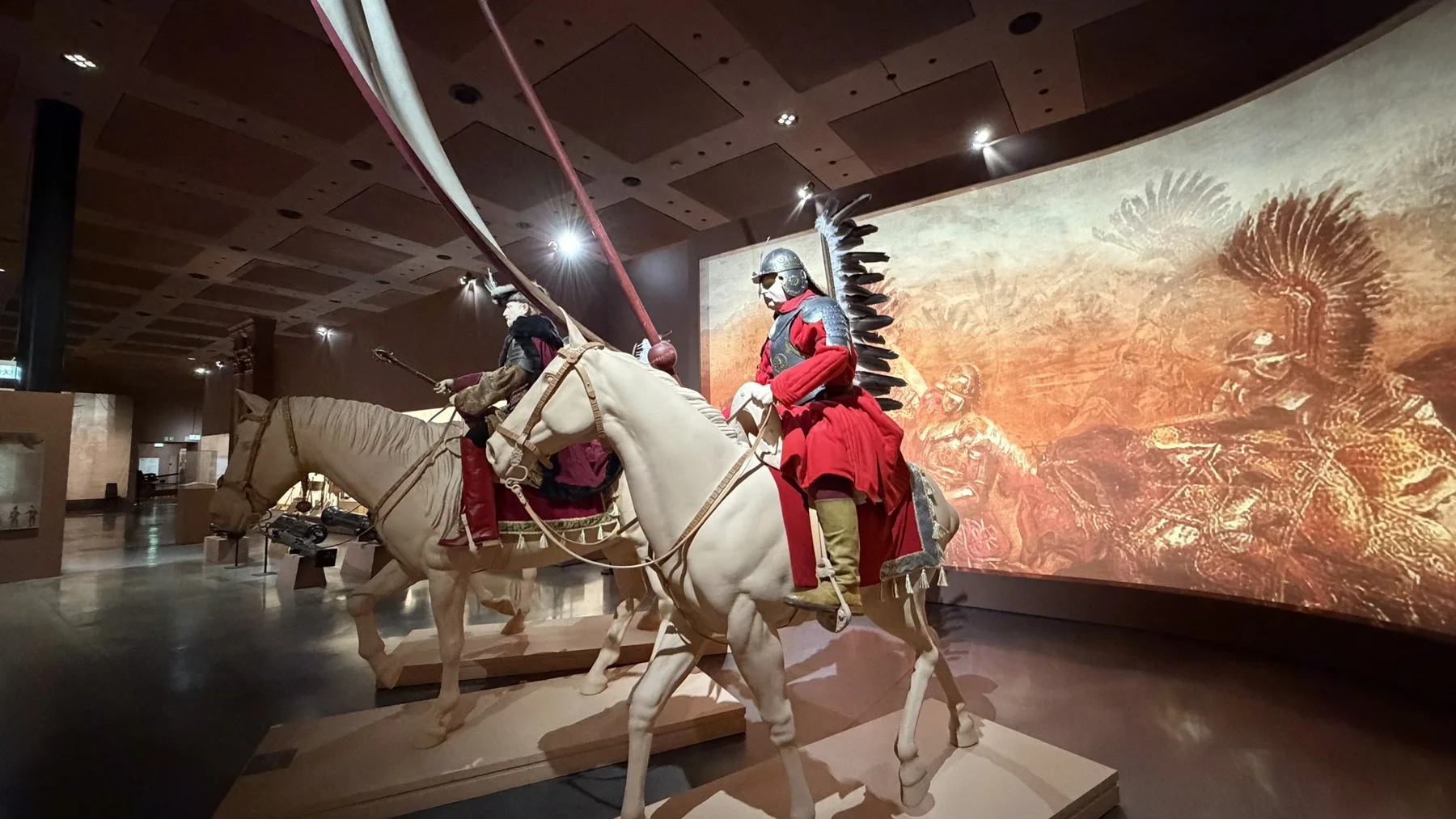
Explore the equipment
1. Helmet · szyszak
A helmet with cheek and neck protection; designs varied.
2. Breastplate · napierśnik
Protected the torso; often decorated with brass fittings.
3. Forearm guards · karwasze
Protected the arms while retaining mobility.
4. Wings
Feathered structures could be attached to saddles or armour; not universal.
5. Horse and saddle
A trained mount and appropriate saddle were essential.
6. Lance · kopia
A characteristic long cavalry lance; not every display includes one.
Equipment guide, not an authentication of individual exhibit components.
The kopia was an exceptionally long cavalry lance; some examples approached six metres. Hussars also carried curved sabres (szable), long straight thrusting swords (koncerze) and pistols. They were participants in the gunpowder age, not simply medieval knights surviving into it.
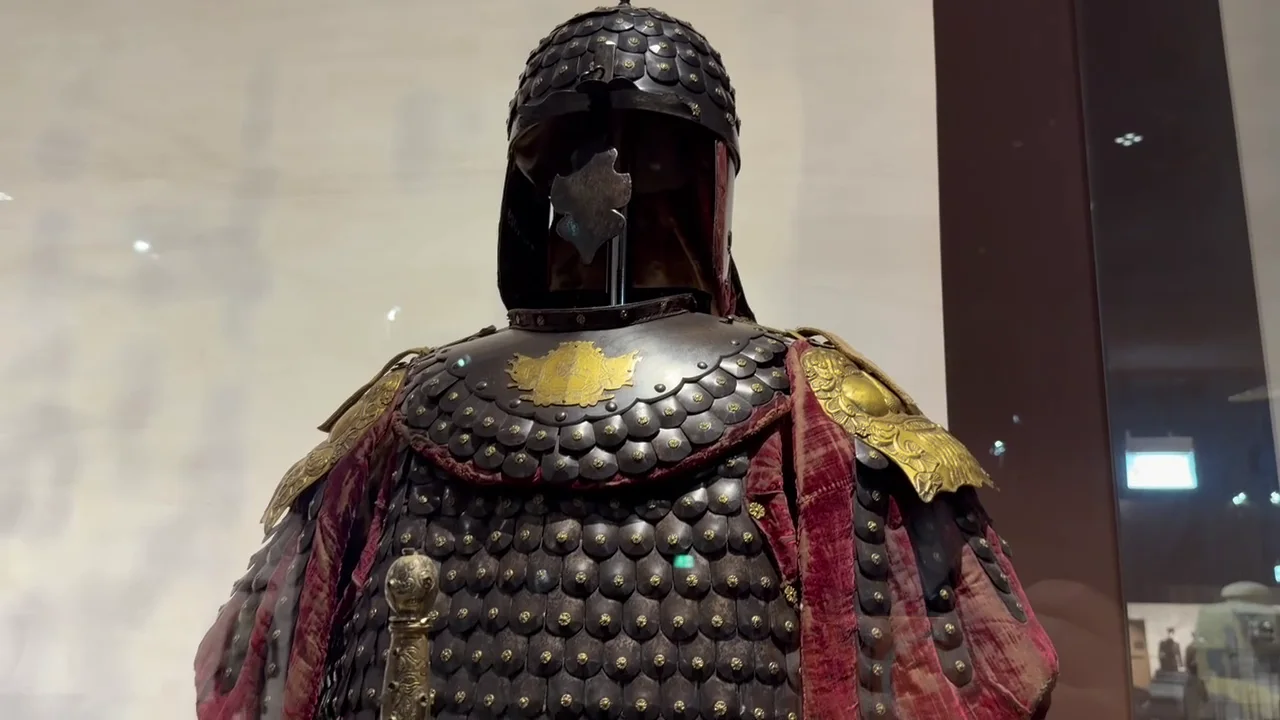
The striking scale armour known as karacena became fashionable among senior commanders in the later Commonwealth, associated particularly with Jan III Sobieski and Sarmatian ideals. It was costly and should not be confused with standard hussar equipment.
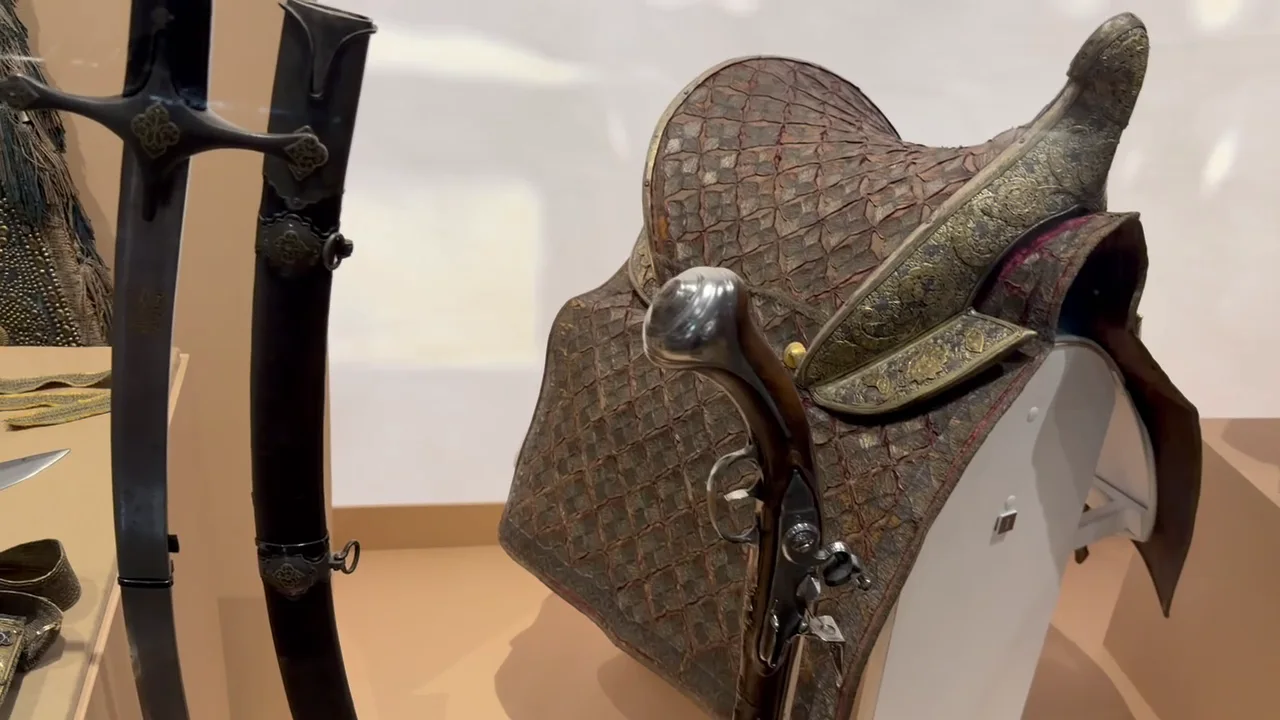
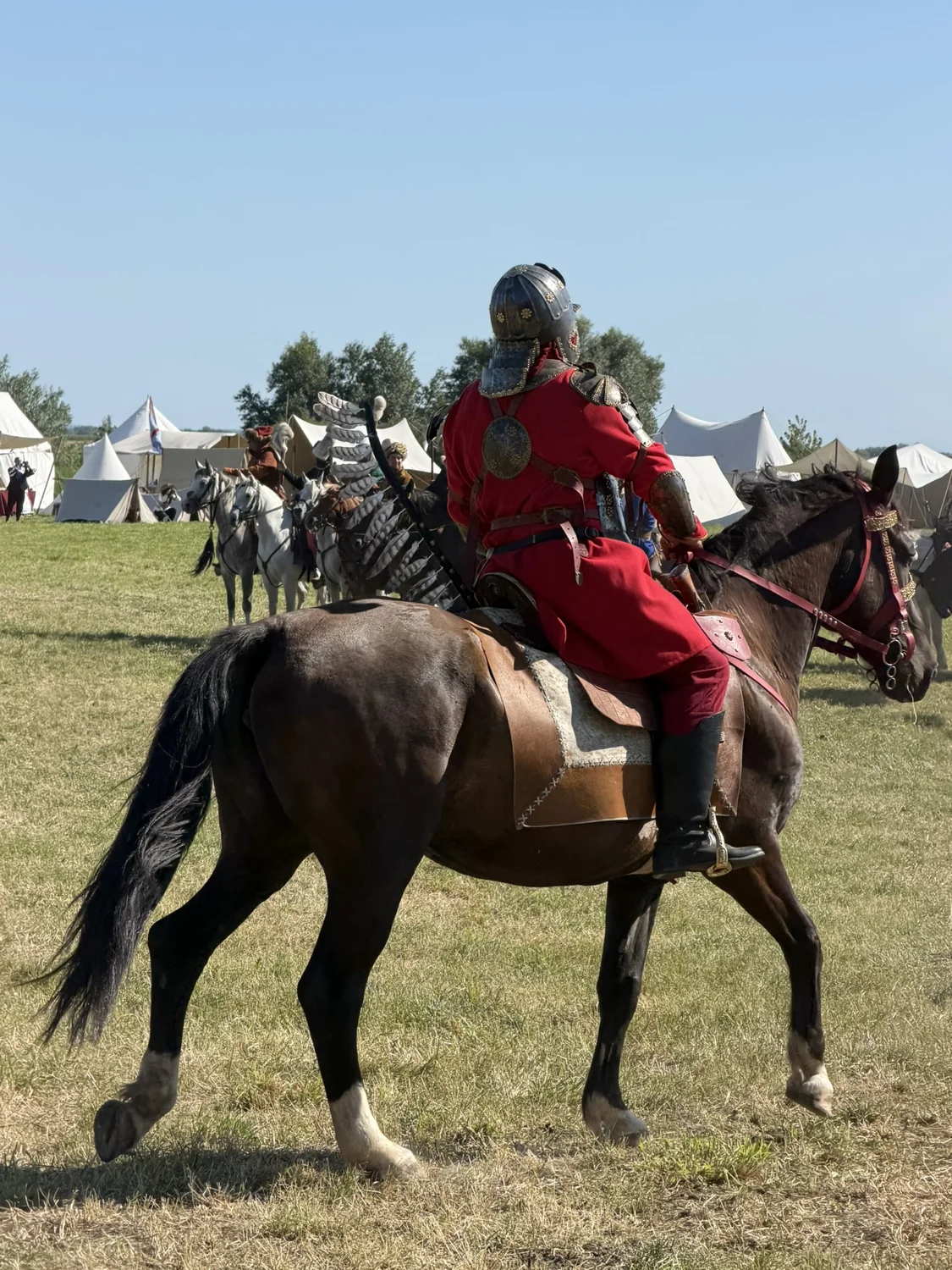
Perhaps the most important component was the horse. Strong, responsive animals able to endure campaigns were highly valued. Eastern bloodlines were prized, but there was no single standardised hussar breed. Without the horse, the armour and wings were little more than expensive possessions.
4. The mystery of the wings
The familiar pair of enormous feathered structures attached to the rider’s back does not represent the full history of the formation. Early feathered decorations reflected traditions from Hungary and the Ottoman frontier. Historical illustrations show feathers associated with shields and later wings mounted behind the saddle. Paired back-mounted wings are particularly associated with later examples. These forms overlapped rather than replacing one another neatly.
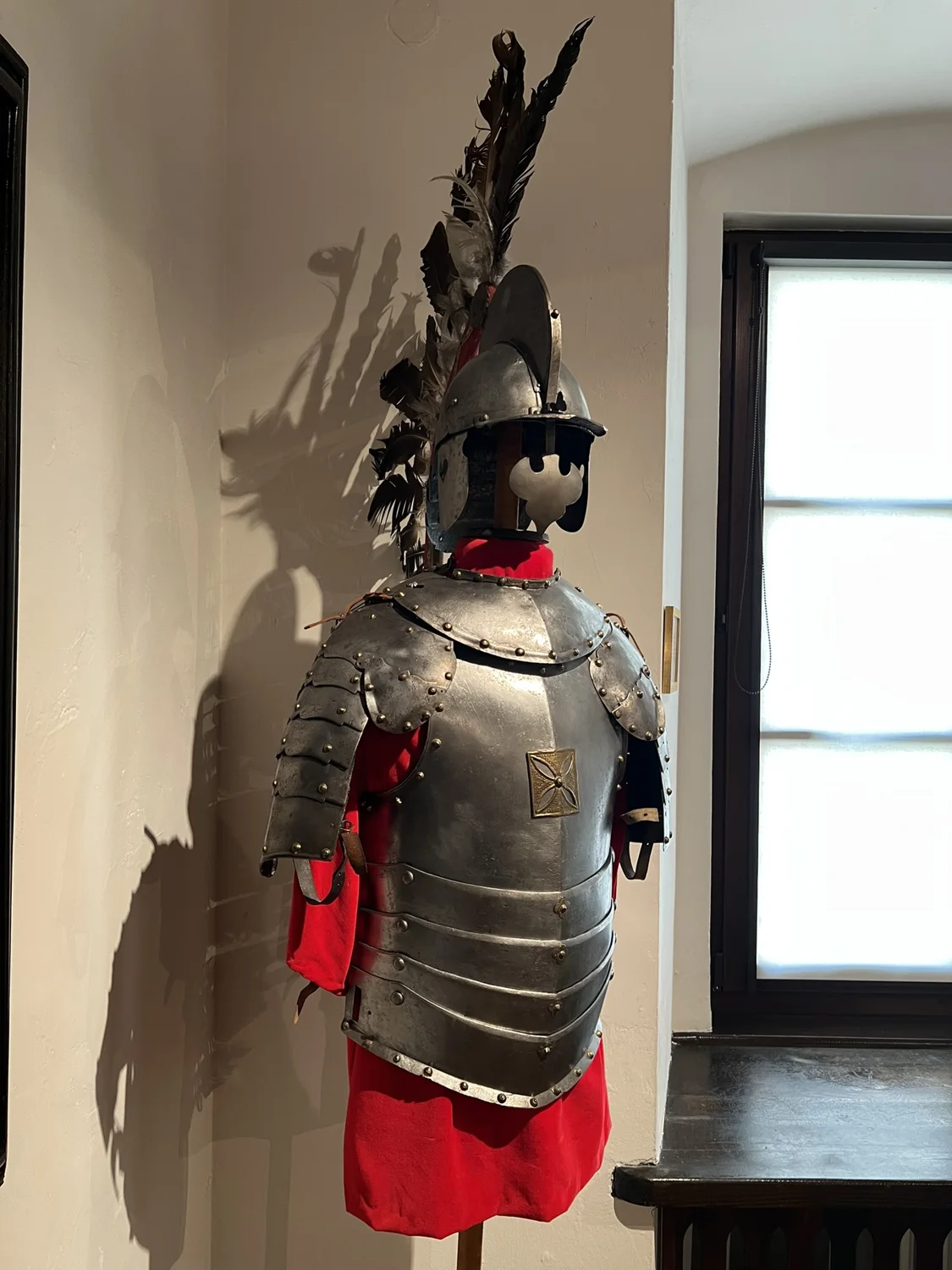
For much of the twentieth century, scholars including Zdzisław Żygulski and Richard Brzezinski questioned how frequently rigid wings could have been worn in combat. Radosław Sikora has argued for actual battlefield use, citing memoirs and images. The French traveller Jean-François Regnard, writing about his 1681 journey, described winged riders and their effect on unfamiliar enemy horses. His account does not establish that he personally witnessed a charge.
The strongest conclusion is that some hussars wore wings in combat, while their form and frequency remain disputed. Sikora has also suggested that some of the wearers were retainers rather than noble companions.
| Proposed purpose | Evidence |
|---|---|
| Intimidating soldiers or making a unit appear larger | Credible historical support |
| Unsettling enemy horses | Some contemporary testimony |
| Identity, prestige and ceremony | Well established |
| Terrifying whistling sound | Weak evidence |
| Protection against lassos or blows | Largely speculative |
Museum displays may combine original armour with reconstructed wings or skins. A striking display is not necessarily an exact record of battlefield equipment.
5. The art of the charge
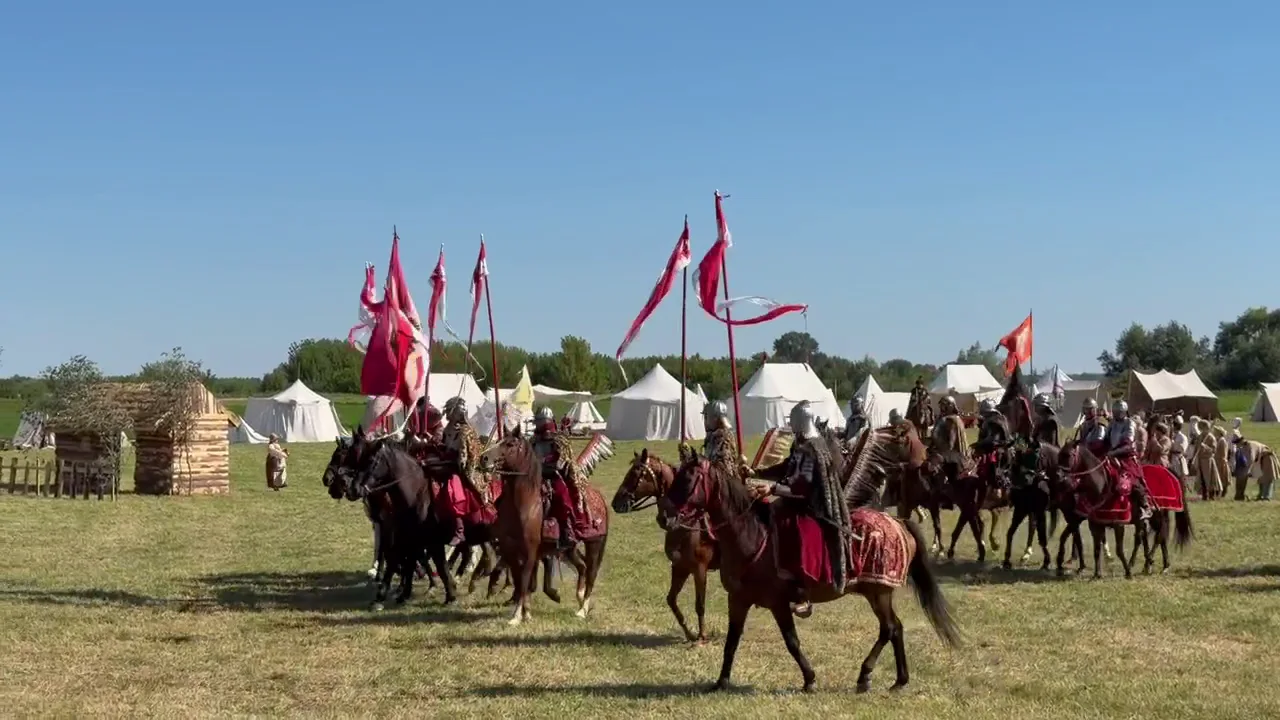
The hussars’ reputation was built on collective discipline rather than individual bravery alone. Controlling powerful horses while maintaining cohesion demanded experience and organisation. Hussars operated within armies that included infantry, artillery, dragoons and other cavalry. The terrain, commanders and circumstances shaped their effectiveness.
At Kłuszyn in 1610, accounts describe units participating in repeated charges during the same battle, an extraordinary demonstration of endurance. Obstacles, fortifications and unfavourable ground could limit cavalry effectiveness. The hussars were exceptional because equipment, organisation, leadership and experience worked together.
6. Two centuries of warfare
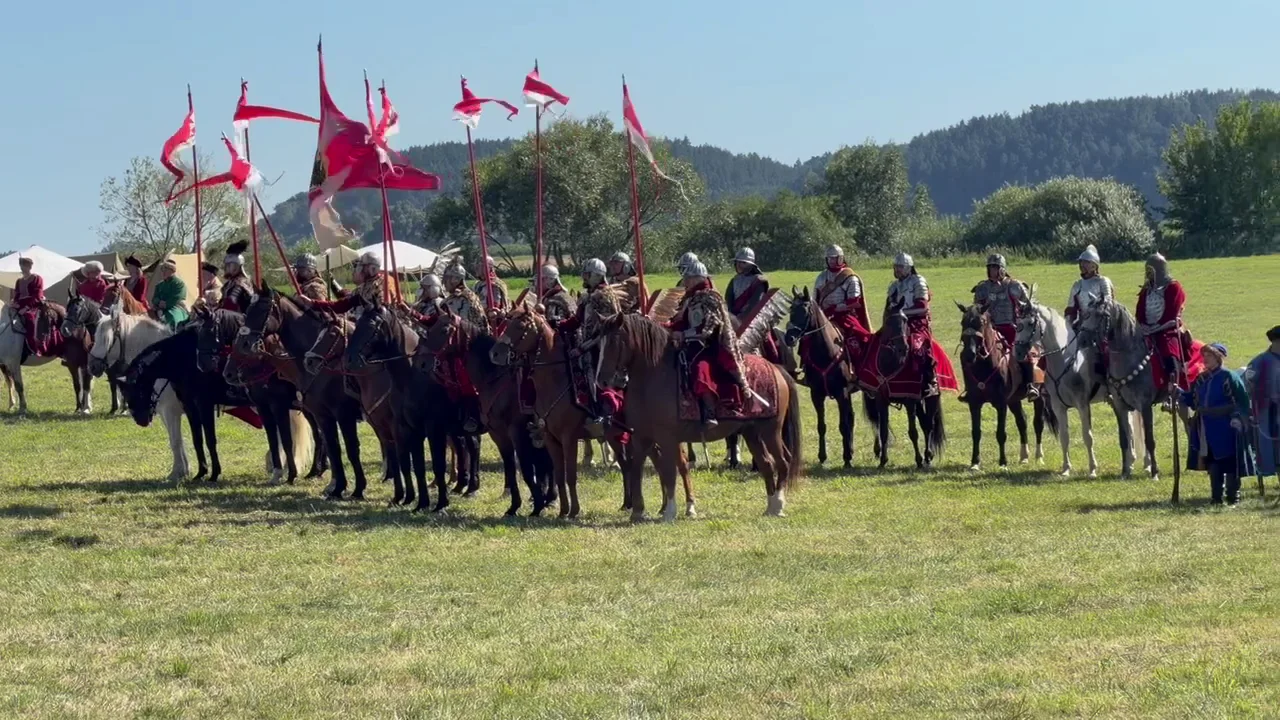
From the Baltic coast to Moscow and Central Europe, the hussars participated in conflicts that shaped the Commonwealth. Follow the selected engagements below; exact army strengths remain disputed in several cases.
- 1577
Lubieszów
Royal forces defeated rebellious Gdańsk’s army, demonstrating the growing effectiveness of reformed cavalry.
- 1588
Byczyna
Jan Zamoyski defeated Archduke Maximilian’s forces, helping secure the throne for Sigismund III Vasa.
Read the battle entry → - 1605
Kircholm
Jan Karol Chodkiewicz’s Lithuanian army defeated a substantially larger Swedish force near present-day Salaspils, Latvia.
Read the battle entry → - 1610
Kłuszyn
Stanisław Żółkiewski defeated a larger Russo-Swedish army, opening the road to Moscow. Troop estimates differ considerably.
Read the battle entry → - 1621
Chocim
Commonwealth and Cossack forces resisted the Ottoman army of Osman II. Hussar counterattacks contributed to the defence.
Read the battle entry → - 1629
Trzciana
Polish and Imperial forces defeated elements of Gustavus Adolphus’s Swedish army.
- 1651
Beresteczko
Hussars participated in a Commonwealth victory over Bohdan Khmelnytsky’s forces and Crimean Tatar allies.
Read the battle entry → - 1656
Warsaw
Lithuanian hussars took part in an ultimately unsuccessful battle against Swedish-Brandenburg forces.
- 1673
Chocim
Jan Sobieski defeated an Ottoman army, strengthening his reputation before his election as king.
Read the battle entry → - 1683
Vienna
Sobieski’s cavalry helped deliver the decisive blow in a coalition victory.
Read the battle entry → - 1683
Parkany
After an initial defeat, Sobieski and Imperial allies secured a victory over Ottoman forces.
- 1694
Hodów
A small force of pancerni and hussars resisted a much larger Tatar force; exact numbers remain disputed.
- 1702–04
Final campaigns
Hussars continued to serve during the Great Northern War, despite diminishing battlefield prominence.
7. The hussars who challenged a king
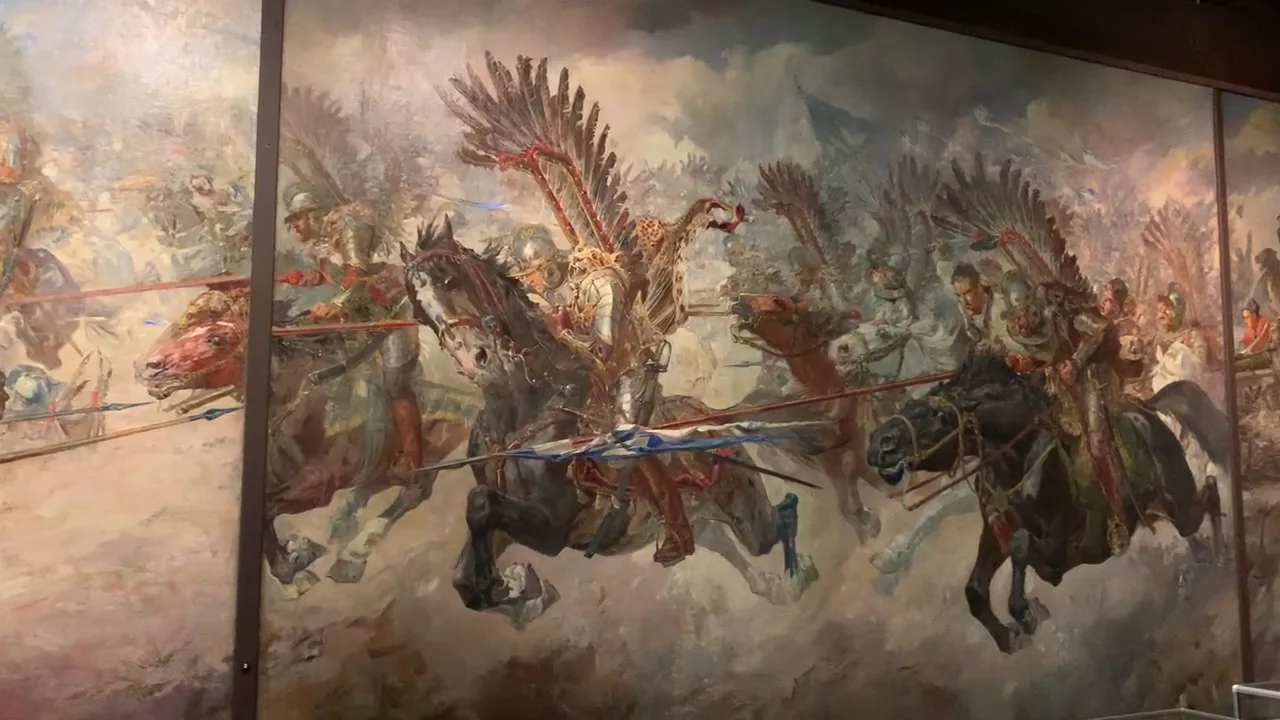
In July 1656 Warsaw became the setting for an extraordinary episode. During the Swedish Deluge, Lithuanian hussars attacked Swedish forces, and two men reportedly came dangerously close to killing Charles X Gustav himself.
Historians Zbigniew Hundert and Andrzej A. Majewski examined a 1672 document naming Wojciech Lipski and Jakub Kowalewski, both of the Łada heraldic clan. Neither survived. Details of the encounter remain disputed, but the episode echoes in the fictional Roch Kowalski of Henryk Sienkiewicz’s The Deluge.
The battle ended in a Commonwealth defeat, yet the episode endured in historical memory. Explore more of the city’s past in the Warsaw guide.
8. Vienna — the charge that became a legend
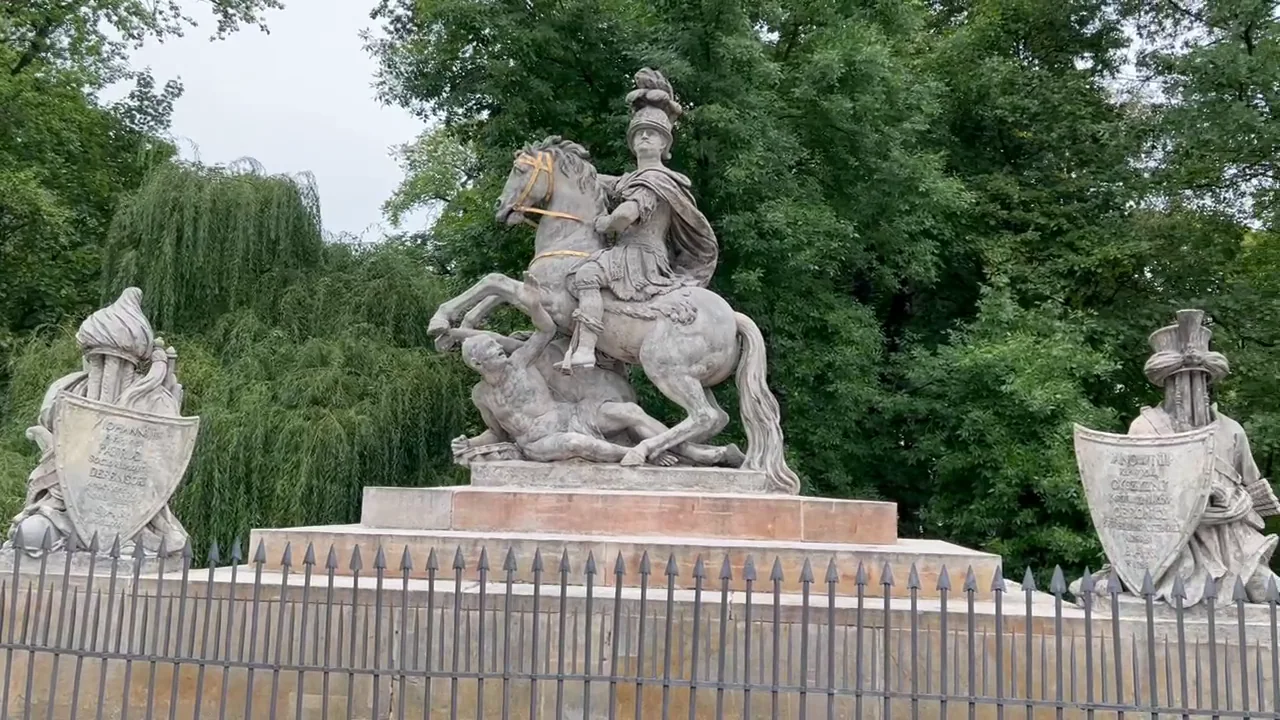
On 12 September 1683, the hussars participated in the event that would define their international reputation. Vienna had endured approximately two months of Ottoman siege warfare under Grand Vizier Kara Mustafa Pasha. Jan III Sobieski assumed supreme command of a relief coalition comprising the Polish Crown and contingents of the Holy Roman Empire.
After hours of fighting, a tremendous mounted attack helped bring the siege to an end. Often described as one of the largest cavalry charges in history, it involved many thousands of riders, only a proportion of whom were hussars. The Lithuanian army arrived too late to participate.
The relief was a coalition victory. Vienna’s garrison, Imperial and German forces, infantry, artillery and other cavalry all played their part. The wider war continued until 1699. Recognising these contributions does not diminish Sobieski’s achievement.
9. When the hussars lost
The popular claim that the hussars remained undefeated for 125 years does not survive scrutiny. Hussars participated in Commonwealth defeats at Cecora in 1620, Batoh in 1652 and Warsaw in 1656. Batoh was especially devastating: the army was defeated and prisoners were subsequently massacred, depriving the Commonwealth of experienced personnel.
At Kliszów in 1702, Commonwealth cavalry faced the Swedish army of Charles XII. The defeat illustrated the difficulties of a changing military environment. Courage, armour and reputation could not compensate indefinitely for wider institutional problems.
10. The last of the hussars
By the eighteenth century, decades of warfare, financial difficulties and political instability had placed enormous strain on the Commonwealth. Military doctrine and firearms also evolved. Historians disagree about how much weight to give technology compared with declining discipline, finance and organisation.
Hussars increasingly appeared at ceremonies, royal occasions and funerals. Regnard described armed riders entering churches during noble funerals and breaking a lance near the coffin, a dramatic expression of military identity and remembrance. The ceremony should not be mistaken for an exclusive hussar custom.
The cavalry reforms of 1775–1776 transformed the remaining traditional hussar and pancerni units into National Cavalry. The historic formation disappeared. Within two decades the Commonwealth itself would cease to exist as an independent state.
11. Myth versus reality
Were they undefeated for 125 years?
No. Hussars were present at major Commonwealth defeats.
Did wings make a terrifying sound?
The visual effect is better documented than any supposed acoustic effect.
Were wings only ceremonial?
Evidence supports some combat use, but its frequency is disputed.
Were all hussars nobles?
No. Companions were generally noblemen, but retainers came from varied backgrounds.
Was their armour so heavy they could not stand?
Typical half-armour permitted mobility; the helpless armoured rider is a misleading image.
Did they save Vienna alone?
No. They played a decisive role in a coalition victory.
Did firearms alone end the husaria?
Historians debate technological, financial, political and institutional causes.
Were they the same as Napoleonic hussars?
No. The later light cavalry differed from Commonwealth armoured lancers.
Did Tolkien base the Rohirrim on the hussars?
No reliable statement from Tolkien establishing this connection has been identified.
12. From warriors to national icons
During the Partitions, when Poland no longer existed as an independent state, artists such as Józef Brandt and the Kossak family recreated the military glories of the Commonwealth. Henryk Sienkiewicz’s historical novels brought seventeenth-century conflicts to life. These works reveal how the hussars were remembered, not necessarily exactly how they appeared in battle.
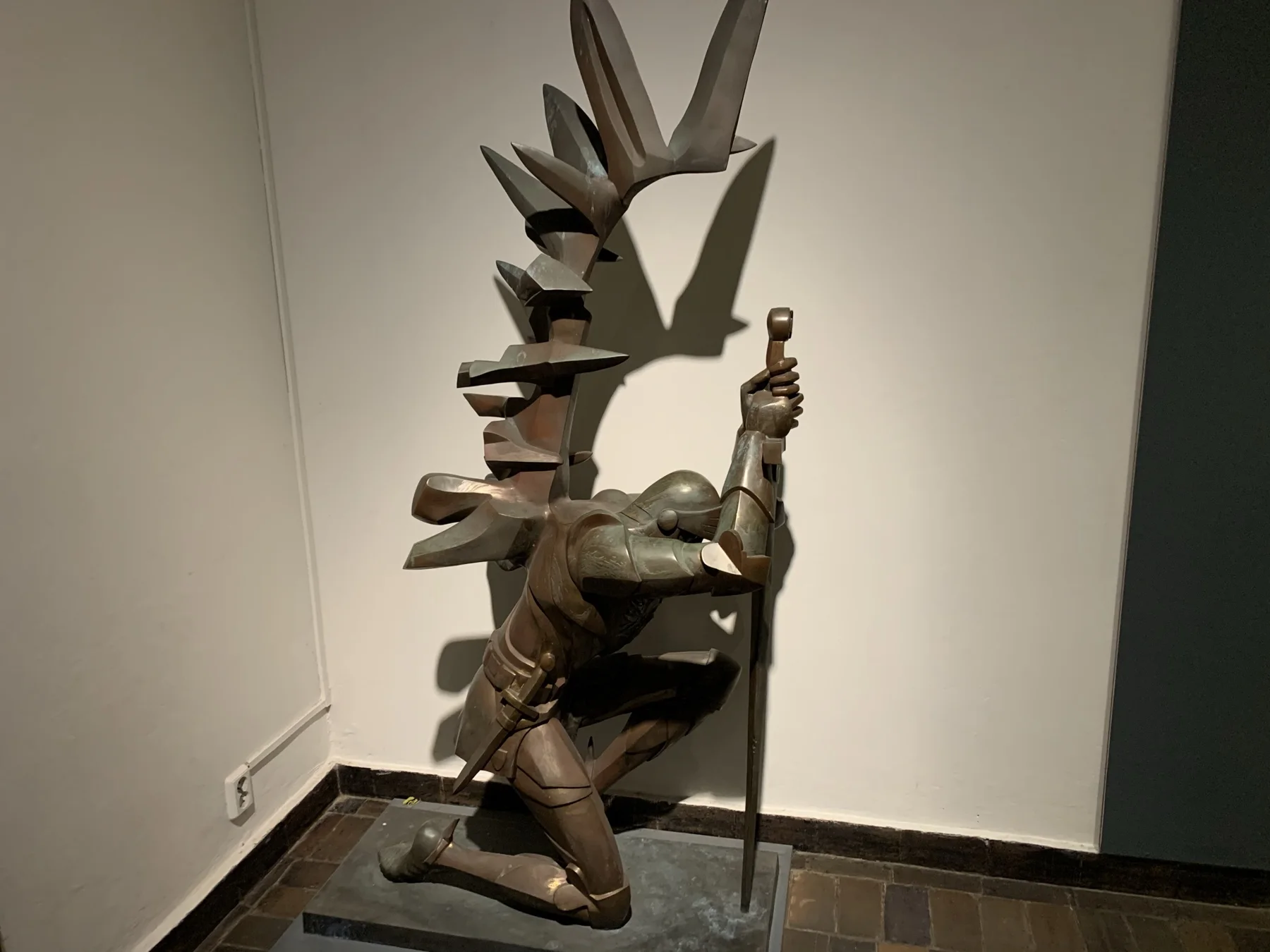
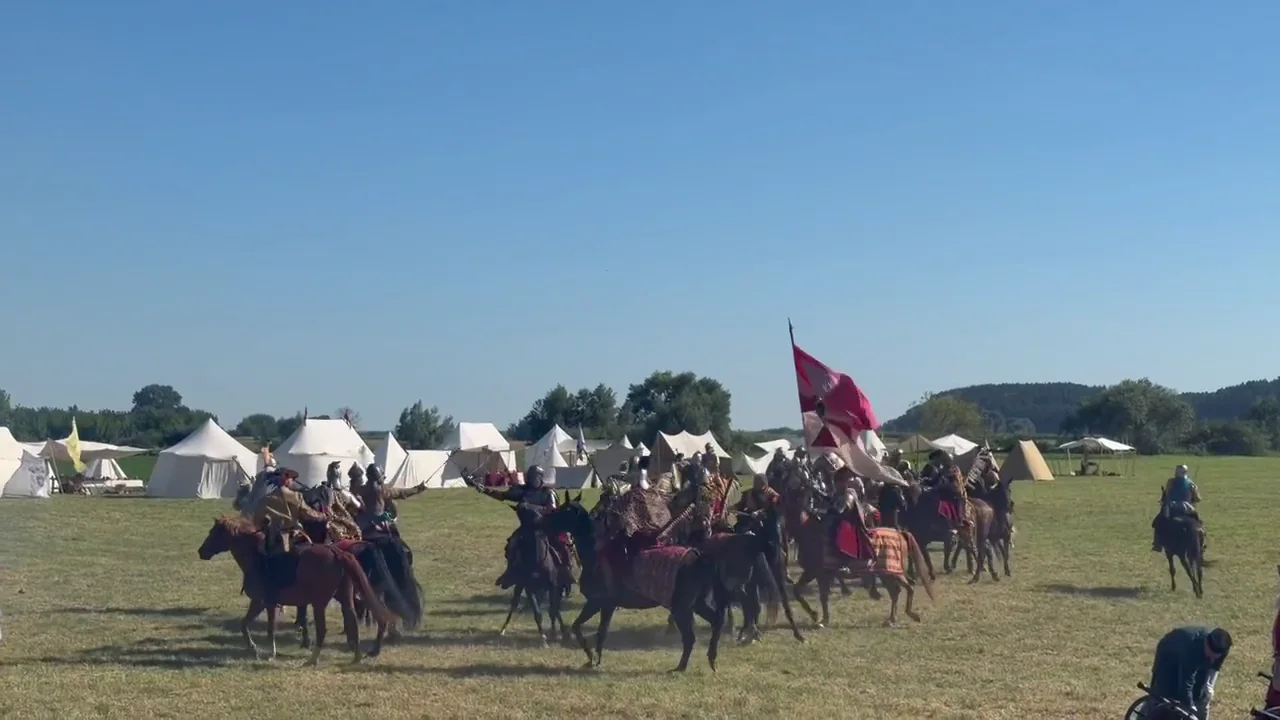
During the Second World War, General Stanisław Maczek’s 1st Polish Armoured Division adopted a badge inspired by the hussar wing and helmet. The symbolism continues in Polish military culture. Reenactment groups bring the appearance of the husaria back to castles and festivals, and the Swedish band Sabaton introduced the Vienna story to new audiences through its song Winged Hussars.
13. Discover the winged hussars in Poland
Surviving armour, weapons and royal residences offer a way to explore the history beyond books. Exhibition contents and event schedules can change; check before visiting.
Polish Army Museum
Warsaw Citadel — military collections and Commonwealth history.
Explore →Wawel Royal Castle
Kraków — royal armoury and treasury.
Explore →Wilanów Palace
Warsaw — the royal residence and legacy of Sobieski.
Explore →Gniew Castle
Pomerania — historical reenactment traditions.
Explore →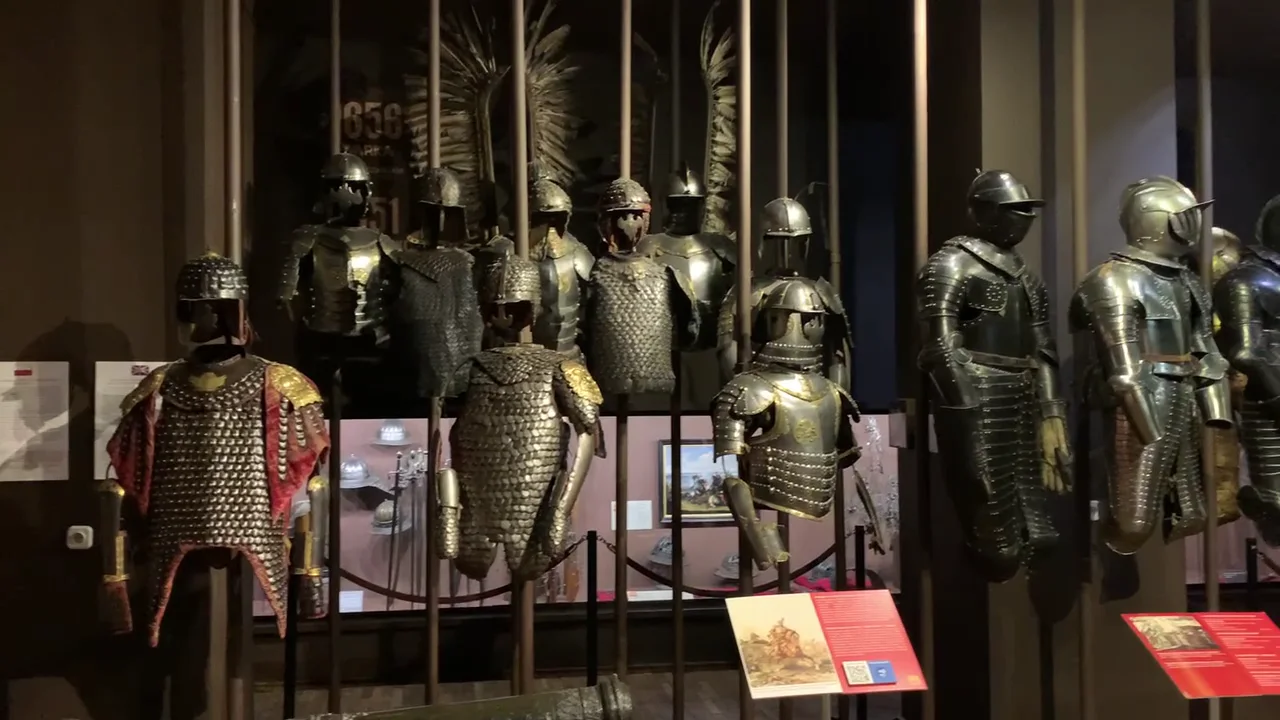
14. Beyond the legend
The winged hussars emerged from a meeting of cultures, developed into an exceptionally effective cavalry formation and participated in conflicts that shaped the Commonwealth. Their achievements were built upon discipline, courage, wealth, organisation and sacrifice. Their failures reveal the limitations of even the most celebrated military formations.
Through political upheaval, occupation, national revival and cultural change, the hussar became a symbol of a nation remembering its own history. The formation disappeared in the eighteenth century. The legend never did.
Sources and further reading
This feature draws on historical research and specialist synthesis. The references below are recommended reading; not every primary text or edition has been independently consulted for this article.
- Richard Brzezinski, Polish Winged Hussar 1576–1775 (Osprey, 2006).
- Radosław Sikora, Fenomen husarii; Z dziejów husarii; Husaria w walce.
- Zdzisław Żygulski Jr., Husaria polska (2000).
- Zbigniew Hundert and Andrzej A. Majewski, “O dwóch Rochach Kowalskich,” Przegląd Historyczny 105/2 (2014), pp. 283–286.
- Jean-François Regnard, account of his 1681 journey, in John Pinkerton, A General Collection of the Best and Most Interesting Voyages and Travels, vol. 1, pp. 217, 219.
- Paweł Tomaszewski, “Husaria najlepsza jazda nowożytnej Europy,” Saeculum Christianum 17/1 (2010), pp. 5–21.
- Jerzy Teodorczyk, “Bitwa pod Gniewem,” Studia i Materiały do Historii Wojskowości 12/2 (1966), pp. 70–172.
- Polish Army Museum · Wawel Royal Castle · Museum of King Jan III’s Palace at Wilanów.
Photographs and video stills from the Brit in Poland archive. Museum object dates and attributions are intentionally conservative where catalogue identification is unavailable. Reenactment images show modern interpretations.