PERSONAL ESSAY · MODERN POLAND · EUROPEAN INTEGRATION
Poland and the EU: Prosperity, Sovereignty and a Turbulent Partnership
How European integration helped transform Poland — and why Warsaw has spent more than two decades arguing with Brussels over the limits of its authority.
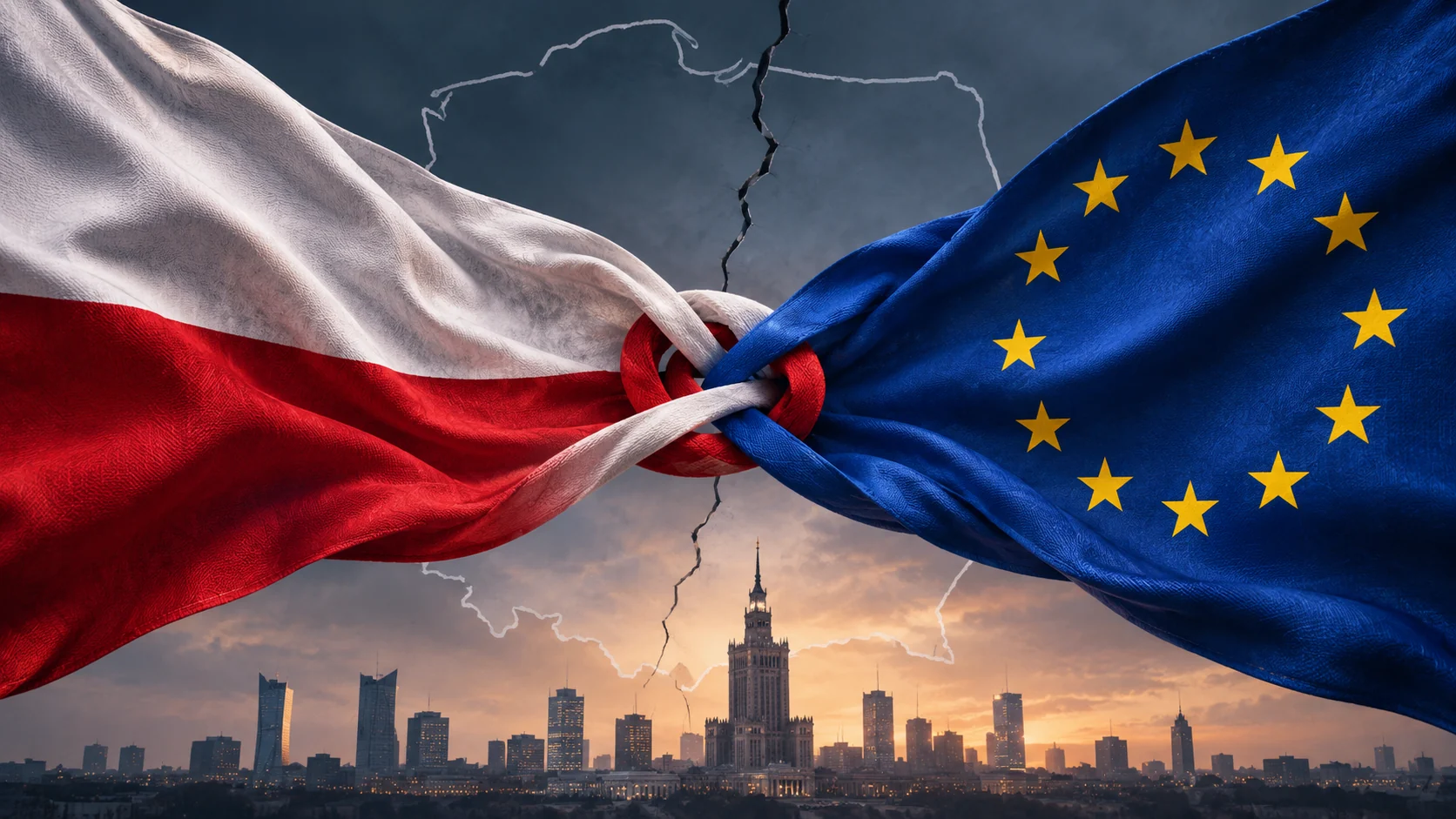
I voted for Brexit. But living in Poland has made me consider how a country can benefit from European cooperation while challenging the limits of shared political power.
A British Eurosceptic’s view of Poland
I voted for Brexit. I have never been particularly enthusiastic about the European Union as a political institution. My objections were not primarily about Britain’s financial contributions, although I questioned those too. They were about sovereignty: who should make our laws, who should be accountable for them, and how much authority a country should surrender to institutions beyond its own democratic system.
I also had concerns about European migration policies, the impact of integration on British industries, and the relationship between British law and European courts. I wanted Britain to have greater control over its own decisions. Whether successive British governments made good use of the opportunities and responsibilities that followed Brexit is an entirely different debate.
Yet here I am, a Brit who has made his home in Poland, a country whose experience of European integration challenges some of the assumptions people make about the EU.
I’ve spent years travelling across Poland, exploring its cities, towns, countryside, industrial heritage and historical landmarks. I’ve seen modern infrastructure connecting places that were once difficult to reach, restored public spaces, new businesses and communities that have changed enormously over the past generation.
It would be unreasonable to ignore the role European integration has played in that transformation. But it would be equally unreasonable to suggest that the European Union built modern Poland single-handedly. Poland’s development is also a story of domestic effort, painful economic reforms, private investment, entrepreneurship and the determination of people emerging from decades of communist rule.
Alongside that transformation runs another story: Poland’s often difficult relationship with the European institutions it voluntarily joined. It is a story about prosperity and opportunity, but also national identity, political disagreement and the boundaries of shared authority.
Can a country benefit from European integration while retaining meaningful control over its own future? Poland’s experience suggests the answer is more complicated than either enthusiasts or critics of the EU might expect.
1. A country determined to return to Europe
To understand Poland’s relationship with the European Union, we need to understand the country that emerged from communism in 1989.
Poland’s modern history includes repeated experiences of lost independence. The partitions of the eighteenth century removed the Polish state from Europe’s political map for 123 years. Independence was restored in 1918, only for the country to be invaded by Nazi Germany and the Soviet Union in 1939.
The Second World War left Poland devastated. Millions of Polish citizens, including approximately three million Polish Jews, were murdered. Warsaw was largely destroyed, cultural heritage was looted or annihilated, and the country’s borders and population were radically altered.
The end of the war did not bring the same political freedom experienced by Western Europe. Poland fell under Soviet domination, and Moscow prevented its participation in the American-backed Marshall Plan for European reconstruction. For decades, while Western European economies integrated within a market-based framework, Poland operated under a communist system of state planning.
When communist rule ended in 1989, Poland faced the enormous task of rebuilding its economy and institutions. The Balcerowicz reforms, introduced in 1990, brought rapid market liberalisation and considerable social hardship. They also helped establish foundations for the economic expansion that followed.
Integration with Western institutions became a major national objective. Poland joined NATO in 1999, while negotiations for European Union membership offered access to a much larger market, development funding, investment and freedom of movement. In June 2003, Polish voters approved EU accession by a decisive majority. On 1 May 2004, Poland formally joined the Union.
For many Poles, this was not simply an economic transaction. It was part of the country’s return to the Western political and economic institutions from which it had been separated during the Cold War.
There is an important historical paradox here. Poland’s experiences of foreign domination help explain why sovereignty can be such a sensitive issue. But those same experiences also encouraged support for Western institutions as a means of protecting Polish independence. Joining the EU could be understood not as surrendering independence, but as securing Poland’s place in Europe.
2. The transformation: what Poland gained
The economic changes following accession were substantial. According to Polish Ministry of Finance data, Poland’s positive net balance of EU budget transfers between May 2004 and December 2023 was approximately €162 billion. Published rounded figures record roughly €245.5 billion received and €83.7 billion contributed; precise totals depend on the reporting series and rounding.
Much of this funding supported infrastructure, regional development, agriculture, environmental improvements and public services. Anyone who has travelled extensively through Poland will recognise the visible results of modernisation. Motorways and expressways link major cities, railway stations and transport systems have been upgraded, and investment has reached towns and rural communities well beyond Warsaw and Kraków. European funding helped finance many of those improvements, although individual projects often combined European, national and local contributions.
The wider transformation goes much further than budget transfers. Poland’s GDP per person, adjusted for purchasing power, rose from approximately half the EU average around accession to roughly four-fifths by the middle of the 2020s. Polish exports expanded dramatically, foreign investment increased, and access to European markets helped domestic businesses participate in international supply chains.
The single market gave Polish manufacturers, farmers, transport companies and service providers new commercial opportunities. Freedom of movement allowed millions of Poles to study, work and establish lives elsewhere in Europe. But this transformation came with costs and trade-offs.
Emigration deprived some Polish communities of younger workers and skilled professionals. Foreign-owned companies benefited commercially from Poland’s development and sometimes repatriated profits. Economic growth remained uneven, while domestic reforms were already producing results long before accession.
It is misleading to attribute Poland’s success entirely to European money. Equally, ignoring the benefits of membership would mean overlooking an important part of the country’s economic development. Nor was the relationship simply one of wealthy countries donating to a poorer neighbour. Western European businesses gained access to a major new market, Polish workers contributed to other European economies, and expanded supply chains benefited firms on both sides.
Poland benefited from Europe, and Europe benefited from Poland. That is the economic relationship I see when travelling through the country. The more difficult question concerns what Poland was expected to accept in return.
3. The złoty: sovereignty without confrontation
One of the clearest examples of Poland retaining important national powers is its currency. More than two decades after joining the European Union, Poland continues to use the złoty rather than the euro.
This is not because Poland negotiated a permanent euro opt-out comparable to Denmark’s. Under its accession arrangements, Poland remains committed to eventual euro adoption once the applicable conditions are satisfied. However, there is no fixed date for that transition.
Poland has not entered the Exchange Rate Mechanism II, an essential stage on the path towards adopting the euro, and successive governments have avoided setting a firm timetable. Maintaining the złoty has allowed Poland to retain its own monetary policy and a floating exchange rate.
During the global financial crisis of 2008–2009, the currency’s depreciation helped cushion the economy against external pressures. Poland was notably the only EU member state to avoid a recession in 2009. That outcome cannot be credited to the currency alone: domestic demand, banking conditions, government policy and other economic factors also mattered.
Nevertheless, monetary independence gave Poland an important means of responding to economic shocks. For someone concerned about sovereignty, the distinction matters. Poland did not need to disregard European law to retain the złoty. It exercised the flexibility available within its membership arrangements. The result is a country deeply integrated into the European economy while continuing to make its own monetary-policy decisions.
4. Migration: the limits of saying no
Few subjects reveal the tensions between Poland and the EU more clearly than migration. During the migration crisis of 2015, EU governments adopted emergency measures requiring participating member states to help relocate asylum seekers from Greece and Italy.
Poland’s government, then led by Ewa Kopacz, supported the September 2015 relocation decision. But after Law and Justice won the parliamentary election later that year, the incoming government opposed implementing the arrangement. Poland briefly indicated an initial commitment concerning 100 places but ultimately relocated nobody under the mechanism.
The government argued that compulsory relocation created concerns involving security, public confidence and the ability of member states to determine their own migration policies. The European Commission pursued legal action against Poland, Hungary and Czechia for failing to fulfil their obligations.
On 2 April 2020, the Court of Justice of the European Union ruled that all three had breached EU law. That judgment imposed no financial penalty.
Here, we need to distinguish two outcomes. Legally, Poland lost. The court ruled that the relocation obligations were binding and that the governments had failed to comply. Practically, Poland resisted the relocations, and the temporary scheme had expired by the time the judgment was delivered.
A government can fail to comply with a binding European decision, obtain its preferred immediate outcome, and still be found to have acted unlawfully. Whether that should be viewed as defending national interests or undermining obligations accepted through treaty is a legitimate subject of political disagreement.
The newer migration pact
The European Union adopted a new Migration and Asylum Pact in 2024, establishing a framework for solidarity that allows different forms of contribution, including relocation, financial assistance and alternative support. Poland opposed important aspects of the arrangements.
Following Russia’s full-scale invasion of Ukraine in 2022, Poland received large numbers of people fleeing the war. It also faced continuing migration pressures along its eastern border with Belarus.
Under Council Implementing Decision (EU) 2025/2642, establishing the solidarity pool for 2026, Poland was recognised as facing a significant migratory situation. The decision recorded Poland’s adjusted relocation contribution as zero, with no financial or alternative contribution specified for Poland in the relevant table.
This meant Poland did not have to accept relocations or make the corresponding financial contribution under that annual arrangement. It was not a permanent exemption from the entire migration pact. The mechanism is reassessed annually, with the Commission’s next migration assessment expected on 4 November 2026.
Nevertheless, the outcome demonstrated that Poland could obtain meaningful relief through the EU’s own procedures. The contrast with 2015 is striking. In the earlier dispute, Poland refused to comply and lost in court. Under the newer arrangements, Poland obtained relief within the European framework.
Both episodes involve national resistance to unwanted migration obligations, but they reveal very different ways of exercising political influence.
5. The courts: when sovereignty meets European law
If migration demonstrates the political limits of European cooperation, Poland’s judicial disputes expose its constitutional limits. The Polish Constitution declares itself the supreme law of the country. The European Union’s legal system operates on the principle that EU law takes precedence in areas within EU competence. These principles have coexisted uneasily in several European countries.
For Poland, the disagreement became particularly intense following judicial reforms introduced by Law and Justice after 2015. The government argued that reforms were needed to address longstanding problems within the judiciary. Critics, including many Polish judges and European institutions, argued that the changes compromised judicial independence and expanded political influence over the courts.
In December 2017, the European Commission initiated proceedings under Article 7 of the Treaty on European Union. Those proceedings were closed on 29 May 2024 without sanctions under Article 7 being imposed. The Commission concluded that Poland had taken significant steps to address its rule-of-law concerns.
Separate judicial proceedings nevertheless produced financial consequences. The dispute over the Disciplinary Chamber of Poland’s Supreme Court led to orders from the Court of Justice and daily penalties beginning in November 2021.
When Poland did not pay the penalties, the European Commission recovered money by offsetting amounts against EU payments due to Poland. The total ran into hundreds of millions of euros. In February 2025, the EU General Court upheld approximately €320.2 million in deductions covering July 2022 to June 2023 alone. That figure should not be mistaken for the full amount accrued since November 2021.
The Disciplinary Chamber was abolished in 2022, although disagreements over the wider judiciary continued. From the EU’s perspective, judicial independence is essential because national courts are responsible for applying and protecting rights arising from European law. From a sovereignty-focused perspective, the concern is that European judicial interpretation can significantly affect how a member state organises its own constitutional institutions.
This is not exclusively a Polish concern. Germany’s Federal Constitutional Court challenged aspects of a European Central Bank and Court of Justice decision in 2020, although the legal circumstances differed substantially from Poland’s judicial reforms.
On 18 December 2025, the Court of Justice ruled in case C-448/23 that the Polish Constitutional Tribunal, in its disputed composition, did not meet EU-law requirements for an independent and impartial tribunal established by law.
On 30 October 2026, that longstanding domestic confrontation intensified when Judge Anna Korwin-Piotrowska ordered a one-month interruption of the official duties of Tribunal President Bogdan Święczkowski and Vice-President Bartłomiej Sochański. The government’s supporters presented the action as part of restoring lawful judicial functioning. President Karol Nawrocki and opposition figures challenged the legality of the measures, with some describing them as a coup.
European judgments form an important part of the arguments about the Tribunal’s legitimacy, but they do not themselves settle every question concerning the domestic procedures used on 30 October. As of 31 October, those questions remained contested, with a General Assembly reportedly planned for 3 November.
For the full background, see our companion article: Poland’s Constitutional Crisis Explained.
One further distinction matters. The European Court of Human Rights, which has also examined Polish judicial appointments, is part of the Council of Europe, not the European Union. Ultimately, Poland’s judicial disputes raise a difficult question: where should the boundary lie between the authority of national constitutional institutions and the legal obligations accepted through European treaties?
6. Turów: when resistance carries a price
The Turów lignite mine near Poland’s border with Czechia provides another revealing example. In 2021, Czechia brought proceedings against Poland over concerns about the mine’s environmental effects, particularly groundwater across the border. The Court of Justice ordered Poland to suspend mining as an interim measure.
Poland declined, arguing that halting operations would threaten energy supplies, employment and regional economic stability. The court subsequently imposed a daily penalty of €500,000 for non-compliance.
Poland and Czechia reached a bilateral settlement in February 2022. The mine continued operating, while Poland agreed to compensation and measures addressing the dispute. However, the settlement did not erase penalties already accrued. Approximately €68.5 million was recovered through deductions from EU funds.
The Court of Justice confirmed in January 2026 that the bilateral settlement did not retroactively eliminate those financial obligations. Again, the outcome was mixed. Poland retained the industrial activity it considered important but incurred financial consequences after refusing to comply with an interim order.
The fact that Poland was challenging an environmental complaint from its Czech neighbour matters too. This was not simply Brussels imposing a policy upon Warsaw. Another member state had sought protection against alleged cross-border harm. Sovereignty disputes are not always confrontations between a national government and European institutions. Sometimes they involve competing national interests, with European law providing the framework through which those disputes are resolved.
7. Poland is not just a rule-taker
Focusing only on Poland’s conflicts with the EU would miss another important part of the relationship. Poland has become a significant participant in shaping European policy, especially towards Eastern Europe.
In 2008, Poland and Sweden jointly proposed the Eastern Partnership, an initiative to strengthen relations between the EU and its eastern neighbours. It was formally launched in Prague in May 2009.
For years, Polish governments also warned about the strategic risks posed by dependence on Russian energy. They opposed projects such as Nord Stream 2, diversified energy supplies and argued for a firmer European approach towards Moscow.
Poland did not always prevail. Nord Stream 2 progressed despite Polish objections, illustrating the limits of Warsaw’s influence over decisions made by larger European partners.
But Russia’s full-scale invasion of Ukraine in 2022 increased the importance of concerns Poland had long raised. Poland became a major centre for humanitarian assistance, military logistics and support for Ukraine. Its geopolitical position gave it an increasingly prominent voice in European security and defence debates.
That influence was not achieved by refusing to participate in European institutions. It came from working within them, building coalitions and advancing proposals.
A more recent dispute: Mercosur
Poland’s disagreements with Brussels have not been limited to governments led by Law and Justice. In 2026, Donald Tusk’s government opposed the EU’s interim trade agreement with Mercosur, reflecting concerns about competition affecting Polish and European agriculture.
Poland failed to prevent the Council’s decision authorising the agreement’s provisional application. It subsequently challenged that decision before the Court of Justice and sought an interim suspension. On 29 September 2026, the Court rejected Poland’s request for interim relief, finding that the requirements for urgent suspension had not been demonstrated. The broader legal challenge was not settled by that interim order.
This provides another example of Poland being unable to secure its preferred result through EU decision-making, even under a government widely regarded as pro-European. Membership gives Poland a voice in common decisions, not a guarantee that it will always obtain the outcome it wants.
8. The money, the war and the question of historical justice
There is another dimension to Poland’s relationship with Europe that I find personally difficult to ignore. Poland suffered enormously during the Second World War. Its cities were destroyed, its people were murdered, and much of its cultural and economic inheritance was lost.
When the war ended, Poland did not enjoy the same opportunities for recovery as countries in Western Europe. West Germany benefited from postwar financial and economic arrangements, while Poland remained subject to Soviet influence and was prevented from participating in the Marshall Plan.
The question of German wartime reparations remains deeply contentious. In 1953, Poland’s communist government declared that it was renouncing further reparations. Germany considers the matter legally settled, while Polish political and legal arguments have challenged the declaration’s circumstances and validity.
A Polish government report published in 2022 estimated the country’s wartime losses at approximately 6.22 trillion złoty. Germany rejected the resulting demand for state-to-state reparations, although various forms of compensation to individual victims have been provided.
The Swedish Deluge of the seventeenth century offers an older reminder of Poland’s history of destruction and cultural loss, including treasures removed to Sweden. Such losses have no direct legal connection to modern EU funding.
This brings me to a personal reflection. When I look at the development funding Poland received after joining the EU, I find it difficult to see that assistance as undeserved. Given the country’s history, particularly its exclusion from Western Europe’s postwar recovery, I can understand the feeling that some measure of historical balance was finally being restored.
That is my moral interpretation, not a statement about the legal purpose of EU funding. EU cohesion policy was designed to reduce regional economic disparities. It was not established as compensation for the Second World War, and Polish governments have maintained separate positions concerning reparations.
Nor did its funding come exclusively from Germany. Countries including Britain, the Netherlands, Denmark and France contributed to the European budget despite very different wartime histories. British taxpayers helped finance development across Poland. That is something I can acknowledge even as someone who voted for Brexit.
We should also recognise that Western European businesses benefited from Poland’s accession through exports, investment and expanded commercial opportunities. The relationship was neither charity nor reparations. It was an economic partnership that helped Poland develop while also creating opportunities for its European partners.
My view is simply that Poland had every reason to benefit from that partnership, given both its historical circumstances and what its people subsequently contributed to Europe’s economy.
9. What do Polish people actually think?
There is a temptation to interpret Poland’s disputes with Brussels as evidence of widespread hostility towards EU membership. Public opinion tells a more complicated story.
According to CBOS polling from January 2026, 82% supported Poland’s EU membership, while 14% opposed it. Attitudes towards further integration were considerably more divided.
Only 26% favoured deepening European integration, while 32% preferred maintaining the current balance. Another 23% favoured increasing national powers, and 5% supported leaving the EU.
When asked whether EU membership excessively restricted Polish sovereignty, 38% agreed, while 50% disagreed. These are revealing distinctions.
A person can value freedom of movement, European markets and economic development while opposing further transfers of authority. Another may view common European laws as safeguards against abuses of power by national governments. Both perspectives form part of the Polish political debate.
Nor is disagreement with Brussels exclusive to one political party. Governments led by both Law and Justice and Civic Platform have opposed individual European decisions, despite taking different approaches to European integration overall.
Poland’s relationship with the EU is therefore shaped by an ongoing debate about what kind of Union its citizens want. And most Poles, judging by the available polling, still favour pursuing that debate while remaining members.
10. Britain and Poland: two different answers to sovereignty
This brings me back to Britain. In June 2016, 51.9% of those voting in the UK referendum chose to leave the European Union. I was one of them.
My decision was primarily about sovereignty. I believed that legislation affecting Britain should ultimately be controlled by institutions accountable to British voters. I questioned Britain’s position as a net contributor to the EU budget, the effects of European policies on particular industries, and the implications of free movement for immigration.
I also had concerns about the European Convention on Human Rights, although that belongs to the Council of Europe rather than the EU. Leaving the EU did not automatically withdraw Britain from the Convention.
I do not believe Brexit’s subsequent difficulties can be understood simply by treating the referendum result as a complete economic or political programme. Leaving an institution and deciding how to exercise the powers recovered are different challenges.
But Poland offers an interesting comparison. Britain joined European integration in 1973 as an established Western economy. Poland joined in 2004 after decades of communist rule, with very different economic circumstances and strategic priorities.
And Britain had negotiated more formal exceptions than Poland possesses today. Before Brexit, Britain had a permanent opt-out from adopting the euro, remained outside the Schengen border-free area, exercised special arrangements concerning justice and home affairs, and benefited from its negotiated budget rebate.
Poland has retained its currency through a different legal arrangement, but it does not possess the same permanent euro opt-out Britain enjoyed. That complicates any suggestion that Poland demonstrates how Britain might simply have negotiated additional exemptions instead of leaving.
Britain had already secured significant flexibility, yet a narrow majority of referendum voters still chose withdrawal. The two countries therefore arrived at different political decisions despite substantial differences in their membership terms.
Poland has remained inside the Union, using treaty provisions, negotiation, political influence and sometimes confrontation to advance its interests. Britain chose to leave, gaining independent authority in areas formerly covered by EU law while losing direct representation in EU decision-making and certain benefits of membership.
Neither decision eliminated economic or political trade-offs. And that leads to an uncomfortable but worthwhile question for a British Brexit voter like myself: if Poland has managed to retain meaningful national autonomy while benefiting from membership, does that tell us anything about whether Britain could have pursued a different relationship?
Perhaps. But the UK already possessed considerable formal autonomy, and that was evidently not enough to resolve the concerns of many voters. I still believe the question of democratic accountability matters. Living in Poland has not made that concern disappear.
It has, however, made me appreciate that sovereignty is not only about having the formal power to reject decisions. It is also about a country’s capacity to influence events, protect its interests and make effective use of the powers it possesses.
11. Has Poland made the EU work on its own terms?
The evidence suggests a complicated answer. Poland has benefited substantially from European integration. Its economic development, trade, infrastructure and international opportunities have been strengthened by membership, even though much of that success originated in domestic reforms and the work of Polish people.
It has retained significant areas of national autonomy, most visibly through its continued use of the złoty. At times, Poland has secured meaningful concessions by negotiating within European institutions, as illustrated by its arrangements under the 2026 migration solidarity mechanism.
In other cases, it has openly resisted legal obligations and experienced adverse judgments, financial penalties or institutional conflict. And sometimes Poland has done something more important than accepting or rejecting EU policy: it has helped shape the Union’s priorities, particularly concerning Eastern Europe and Russia.
This is not a story of a country enjoying European benefits without accepting European rules. Nor is it a story of a country that has surrendered every meaningful aspect of its sovereignty. It is the history of a state operating inside a political and economic union, continuously negotiating the balance between cooperation and self-government.
I remain sceptical of concentrating political authority too far from the people affected by it. My years in Poland have not made that concern disappear. They have, however, made me recognise that economic integration, national independence and political influence are not always mutually exclusive.
Perhaps Poland’s experience shows that retaining national influence is not always a matter of defying European rules. Sometimes it is about understanding where those rules allow flexibility, negotiating effectively, and being influential enough to help change the rules themselves.
For Poland, the argument is far from settled. And judging by its first two decades inside the European Union, the conversation between Warsaw and Brussels is unlikely to become a quiet one any time soon.
Sources and further reading
- Polish Ministry of Finance — EU budget transfers
- Warsaw School of Economics — EU financial flows
- CBOS — Poles on European Integration, 2026
- CJEU — 2015 relocation judgment
- EU Council — 2026 solidarity pool
- Polish Ministry of Foreign Affairs — Eastern Partnership
- UK Electoral Commission — EU referendum results