
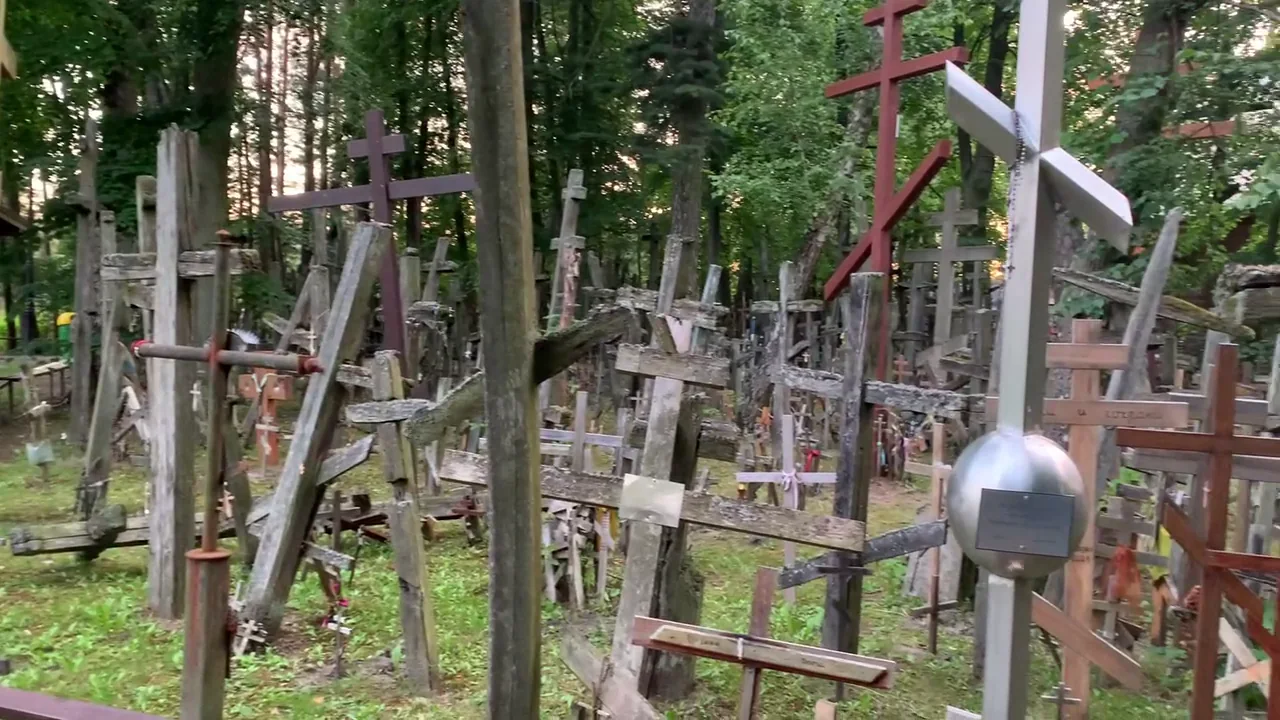
A forest of crosses
Arrive at Grabarka, near Siemiatycze, and the first sight is unforgettable: crosses of different ages, sizes and materials crowding the trees around a small Orthodox church. Some carry names. Some carry prayers. Together they form an archive of personal devotion left in public view.
For Poland’s Orthodox communities, Grabarka is among the country’s holiest places. Unlike a monument built once and then finished, its landscape is continually remade by worshippers.
The story of the epidemic
Tradition links the hill to the cholera epidemic of 1710. In commonly retold versions, an elderly man received a dream or vision instructing people to seek the hill, carry a cross, pray and drink from its spring. Those who followed the instruction were said to have survived. The supernatural direction and healings are the content of the tradition, not medically established facts.
Local religious history may be older than the epidemic narrative, including devotion to an image of the Saviour. We should not assume that the 1710 story was the literal beginning of every sacred association with the area.
Carrying a prayer uphill
The practice of carrying a cross up Grabarka gives the place its most recognisable form. Crosses may mark grief, gratitude, hope for recovery or prayer for another person. The hill tells many intimate stories without identifying their authors.
Around the Feast of the Transfiguration, observed on 18–19 August in the local church calendar, pilgrims arrive from across Poland. Many have walked for days. Some worshippers circle the church on their knees. These are living religious practices, best viewed with respect rather than as a spectacle.
Destruction and rebuilding
The Monastery of Saints Martha and Mary was established in 1947, and a parish followed in 1948. The wooden Church of the Transfiguration was destroyed in an arson attack in 1990 and subsequently rebuilt. Grabarka’s history therefore includes modern loss and reconstruction as well as much older memory.
The continuity of pilgrimage across these disruptions is one reason the place matters to Poland’s Orthodox communities, including families with Belarusian and Ukrainian cultural roots.
The place behind the tradition
The story of Grabarka is not reducible to a single miraculous claim. It is the conjunction of an origin tradition, a chapel and monastery, a sacred spring, and an evolving forest of offerings. That is why its strongest photograph may simply be the crosses among the trees.
This account describes Orthodox beliefs in their own context; it does not apply Roman Catholic categories of apparition approval to an Orthodox pilgrimage tradition.