
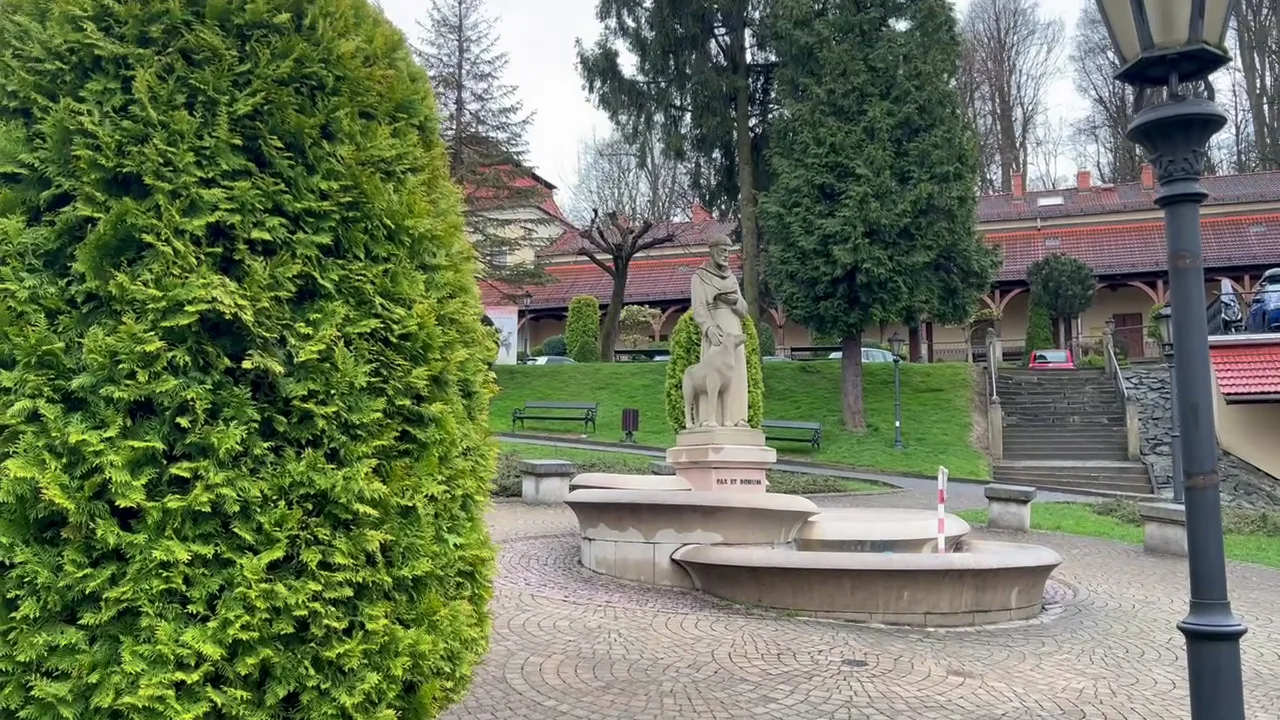
Jerusalem in the hills of Małopolska
At the beginning of the seventeenth century, Mikołaj Zebrzydowski began transforming a landscape south-west of Kraków into a place where pilgrims could follow the Passion of Christ without travelling to Jerusalem. In 1600 work began on a chapel of the Crucifixion. In 1602 Bernardine friars were invited to establish a monastery.
Chapels and paths multiplied across the wooded hills, echoing sacred geography through architecture and walking routes. The landscape did not simply contain religious buildings. Its hills, distances and processional journeys became part of the devotional experience.
Three crosses in the sky
A later tradition says Zebrzydowski saw three burning crosses above the hill and took the sight as a call to found the sanctuary. It is a memorable origin scene, but it must be presented as a foundation legend rather than evidence of a documented supernatural apparition.
For historical purposes the reliable foundation lies in the nobleman’s patronage, the Bernardine community and the surviving designed landscape. For cultural history, the vision story helps explain how believers remembered the sanctuary’s beginnings.
The image said to have wept
The Marian devotion acquired a separate story in 1641. Stanisław Paszkowski gave the friars an image of the Virgin. According to sanctuary tradition, the painting had shed tears in his house and unusual events accompanied its journey to Kalwaria. The image became a focus of prayer and received a dedicated chapel, completed in 1667.
These accounts belong to the history of religious belief and the sanctuary’s own chronicles. The donation, chapel and later public devotion can be investigated through records; the reported tears should remain explicitly attributed to tradition. The image was crowned in 1887.
A story performed every year
The sanctuary is not just remembered; it is repeatedly enacted. During Holy Week, pilgrims follow an outdoor Passion narrative through the chapels and hills. Marian processions also move through this carefully shaped sacred geography. The physical effort of the journey matters: to walk here is to take part in the narrative.
This is why Kalwaria belongs in a collection about devotion, even though it is not centred on one verifiable miracle claim. It illustrates how ritual, storytelling, architecture and collective memory reinforce one another over centuries.
Heritage beyond the miracle claim
Karol Wojtyła grew up near Kalwaria and retained a lasting connection with the shrine. In December 1999 UNESCO placed its distinctive Mannerist architectural and park landscape on the World Heritage List. Those recognitions concern different aspects of the place: one religious and personal, the other cultural and architectural.
A visitor can explore the Basilica of Our Lady of the Angels and the network of chapels, but this feature should link to the separate Sacred Places directory for detailed practical guidance. Here the central subject remains how a landscape became a living religious story.