
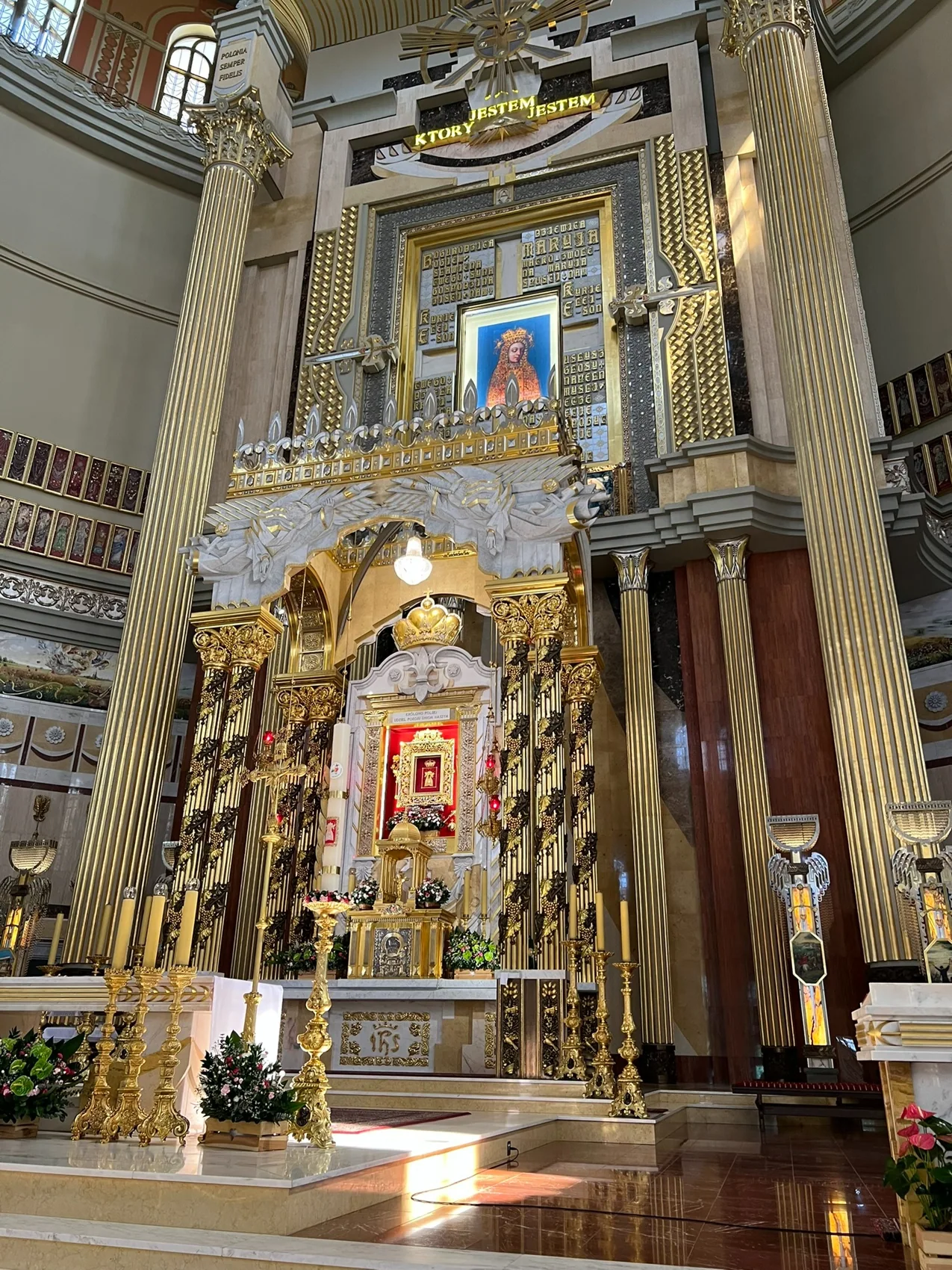
A basilica and a tiny image
The Basilica of Our Lady of Licheń is enormous. Yet the devotion at its heart centres on a remarkably small image of the Sorrowful Mother, with a Polish white eagle depicted on her chest. That contrast — monumental church, modest painting — offers a good way into the sanctuary’s layered history.
Licheń Stary, near Konin, has become one of Poland’s best-known Marian pilgrimage destinations. Its origin story, however, begins well before the modern basilica, and its most dramatic moments come to us as religious tradition.
The soldier at Leipzig
According to the traditional account, Tomasz Kłossowski was seriously wounded during the Battle of Leipzig in 1813 while serving in Napoleon’s forces. He reported seeing Mary, who promised his recovery and asked him to seek an image of her. More than two decades later, in 1836, he supposedly found that image at Lgota and hung it on a pine in the forest near Grąblin.
The battle is a historical event. The vision, recovery promise and discovery narrative are preserved through later devotional tellings rather than contemporary documentation proving each element. Our language should preserve the mystery without quietly converting it into fact.
The shepherd and the warnings
In 1850 a local shepherd, Mikołaj Sikatka, reportedly experienced a series of Marian apparitions at the forest image. Tradition says the messages urged repentance and prayer and warned of coming hardship. Later accounts connected the warnings with the cholera epidemic that struck in 1852.
The apparent fulfilment of a prophecy makes a compelling story — and it makes accurate dating of the earliest testimony especially important. Claude could not locate the frequently mentioned 1852 parish report. Until that document is recovered, the warning and its timing must remain explicitly attributed to tradition.
From pine tree to parish church
The image was moved to Licheń’s parish church in September 1852. It was crowned in 1967 by Primate Stefan Wyszyński, and the Marian Fathers later oversaw the construction of a monumental new basilica. The image was installed there in 2006.
These are identifiable stages in the growth of a sanctuary, unlike the reported visions themselves. Crucially, the public veneration of an image and its coronation are not evidence that Church authorities formally judged Kłossowski’s or Sikatka’s experiences supernatural. No such formal judgement has been established.
The forest is still part of the story
Visitors can encounter more than the basilica. The Grąblin forest chapels and the older religious sites help connect the vast present-day complex to the smaller-scale traditions from which it developed.
Licheń is therefore both a story of reported apparitions and a history of how popular devotion changes a landscape. The basilica’s distinctive architecture and public reception are another chapter, but they should not obscure the more intimate image and forest at the origin of the tradition.