
A miracle dated centuries later
According to Wambierzyce’s founding tradition, a blind man named Jan prayed before a figure of Mary in the hollow of a linden tree and regained his sight in 1218. Retellings disagree on the village from which he came, and there is no surviving document written in 1218 that records the event.
The earliest identified printed account belongs to 1695, almost five centuries after the miracle it described. That gap is not a reason to dismiss the importance of the story; it is essential information about how the story reached us.
Albendorf before its transformation
The village was long known by its German name, Albendorf. Its documented history includes a medieval settlement and church, but the landscape familiar to visitors today is primarily an ambitious Baroque creation.
The surviving Marian statuette is small — around 28 centimetres high — and its Gothic character does not on its own establish a thirteenth-century date. That makes the contrast between humble object and monumental setting all the more striking.
Building a new Jerusalem
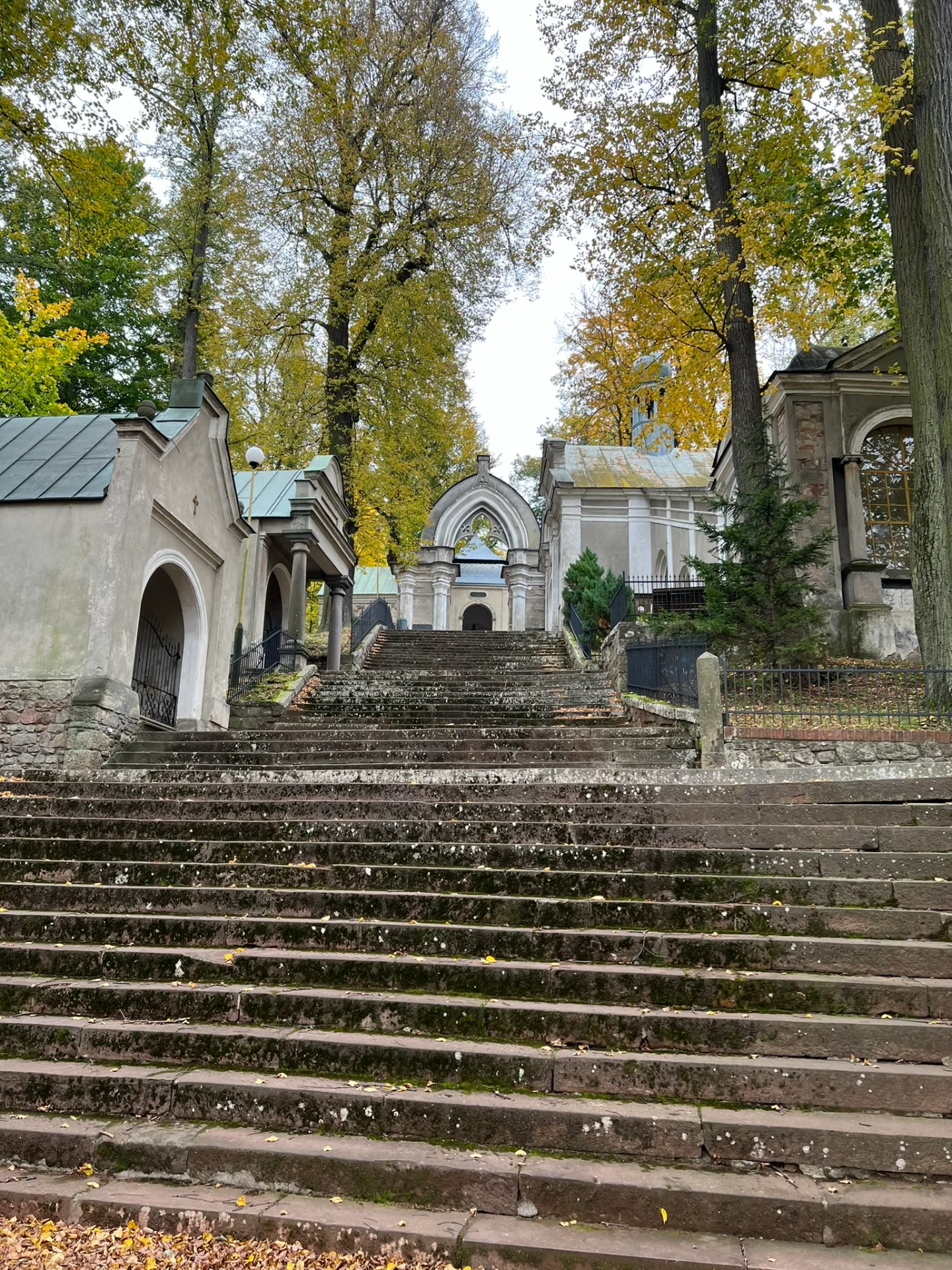
Beginning in the late seventeenth century, Daniel Paschasius von Osterberg developed a devotional landscape modelled on Jerusalem. Surrounding hills were given biblical names; routes, gates, chapels and stations invited pilgrims to walk through sacred history. A new church was begun, but the structure proved unstable and was replaced.
The present basilica was constructed from 1715 under Count Franz Anton von Goetzen. Its monumental stairway, theatrical façade and extraordinary setting turned this small village into the ‘Silesian Jerusalem’.
Borders change, pilgrims remain
The Kłodzko region passed through Bohemian, Prussian, German and Polish political frameworks. Wambierzyce remained tied to the Archdiocese of Prague long after its political borders changed. It became a minor basilica in 1936.
After 1945 its German community was displaced and Polish settlers arrived. The Marian devotion continued, and the image was crowned in 1980. People with roots in the former German Albendorf still return.
What visitors can read in the landscape
The basilica, stairway and Calvary make the history visible. A visitor need not regard the ancient healing account as proven to appreciate the village’s extraordinary architectural transformation.
Wambierzyce’s enduring story is a convergence: a medieval-style miracle tradition, noble patronage, pilgrimage theatre and shifting borders, all written into the hills of Lower Silesia.