Warsaw Orthodox Cemetery: The Eastern Memory of Wola
Golden domes, old crosses and a quieter history of Warsaw — faith and family through empire, war and change.
Begin the story ↓After years of exploring Warsaw’s streets, I can still find whole chapters of the city hiding behind a gateway. This cemetery was one of them. Its church glows above the trees, but the real story lies among the grave paths: people whose lives crossed empires, languages, faiths and generations.
Here is the Orthodox side of Warsaw — told through the place itself and the photographs taken on our visit.
The Eastern Memory of Wola
Warsaw is often introduced through its Catholic churches and royal history. Walk into the Orthodox Cemetery on Wolska Street, however, and another city begins to appear: shaped by eastern Christianity, changing borders, migration and generations of families whose stories rarely feature in a first-time visitor’s itinerary.
The cemetery is still a place of worship and burial. Its quiet avenues combine monumental stone crosses, family chapels and the kind of ordinary gravestones that make history feel personal. The fact that it is beautiful does not make it a museum: people continue to remember their loved ones here.
Why an Orthodox cemetery appeared here
The decision to create a dedicated Orthodox cemetery was taken in 1834, when Warsaw was under Russian imperial rule. It opened in 1841. Earlier Orthodox burials had been made in other cemeteries, but the expanding community now had a separate burial ground.
The founding dates are inseparable from the era after the November Uprising of 1830–31. The nearby church of St Lawrence was converted for Orthodox use under the tsarist authorities, a reminder of the political pressure accompanying religious change. Yet it would be a mistake to read every grave here simply as a symbol of imperial rule. Buried families had their own traditions, loyalties and lives; later arrivals added still more layers to the site.
St John Climacus: the church at the cemetery’s heart
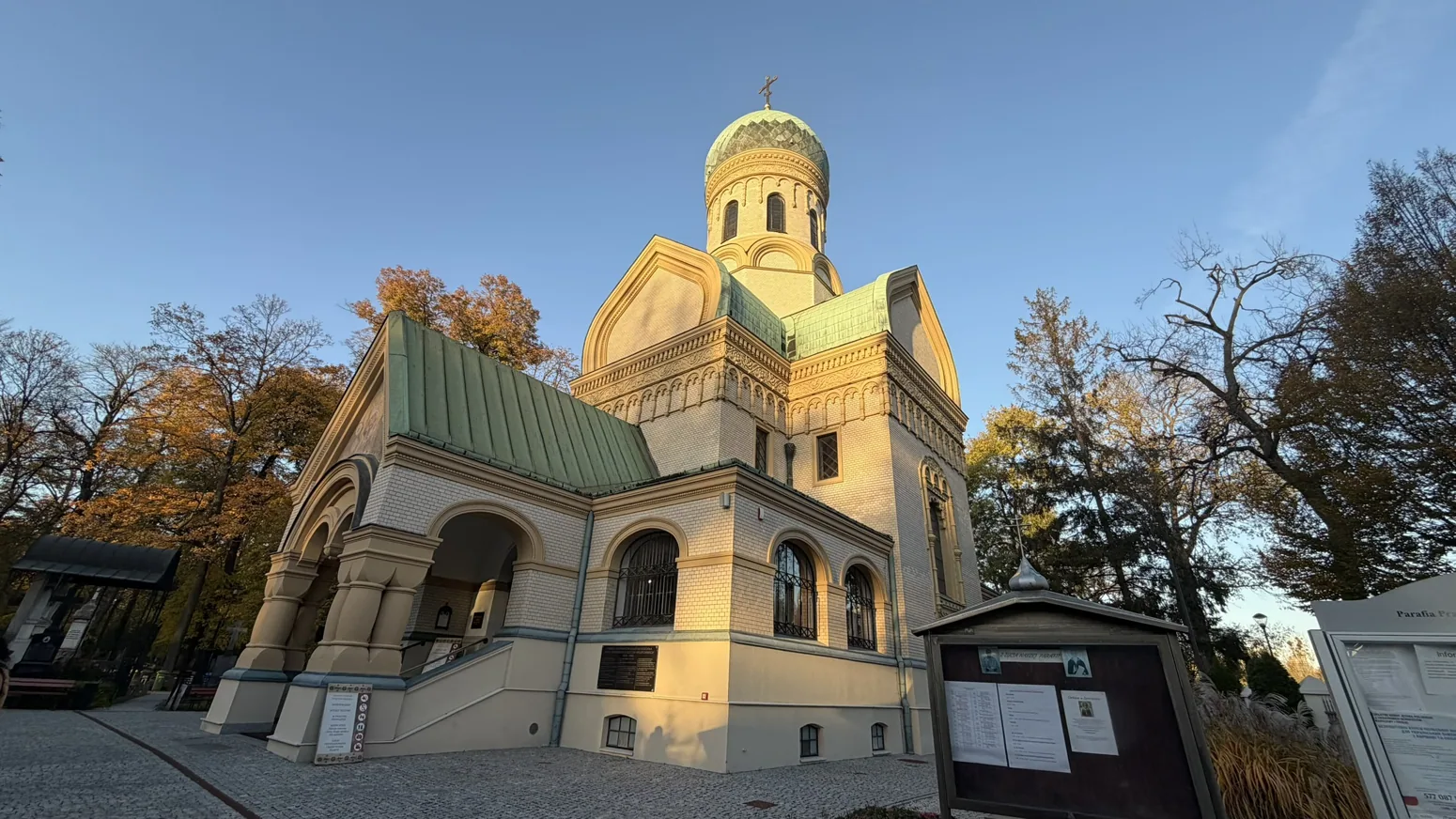
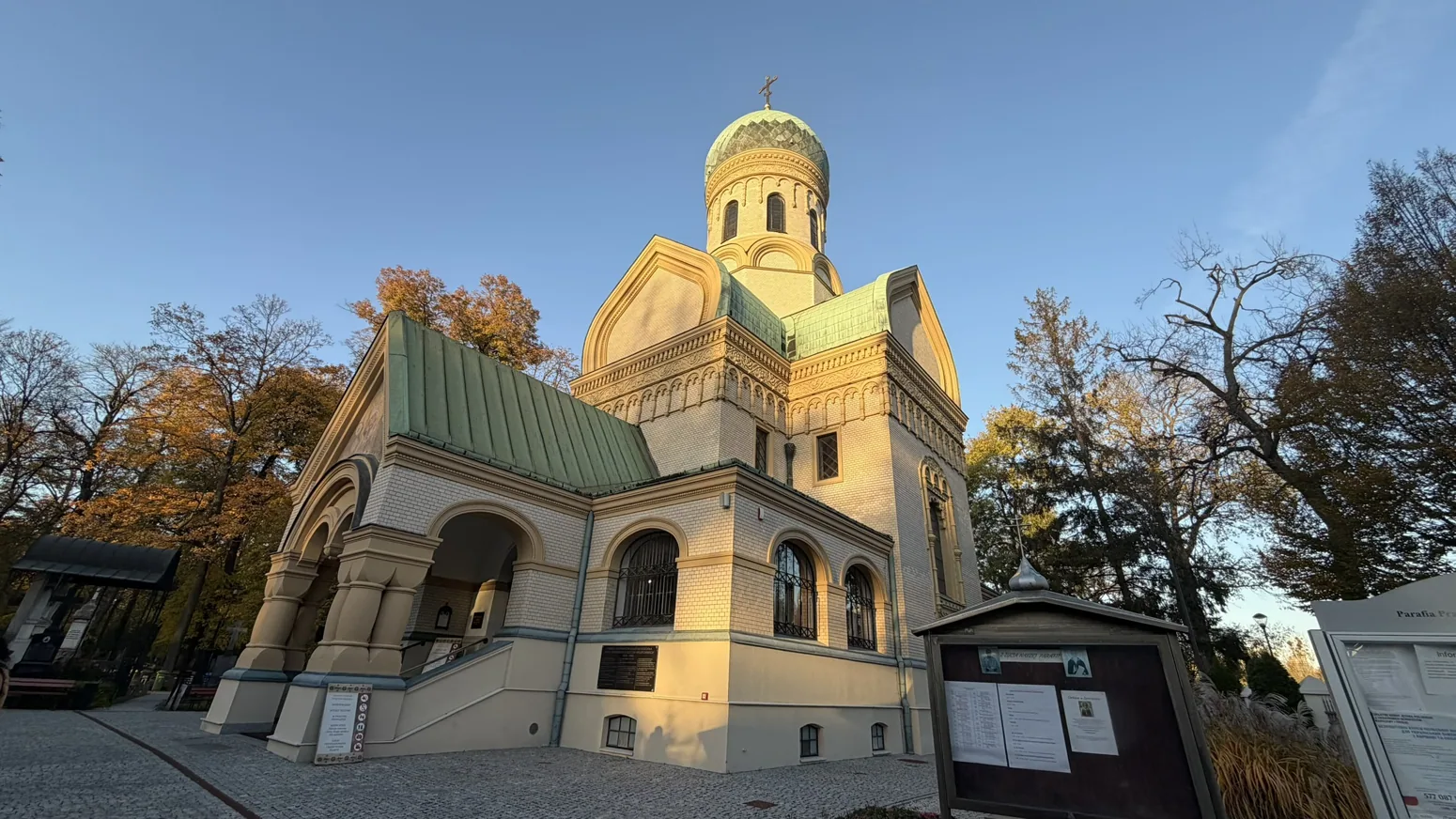
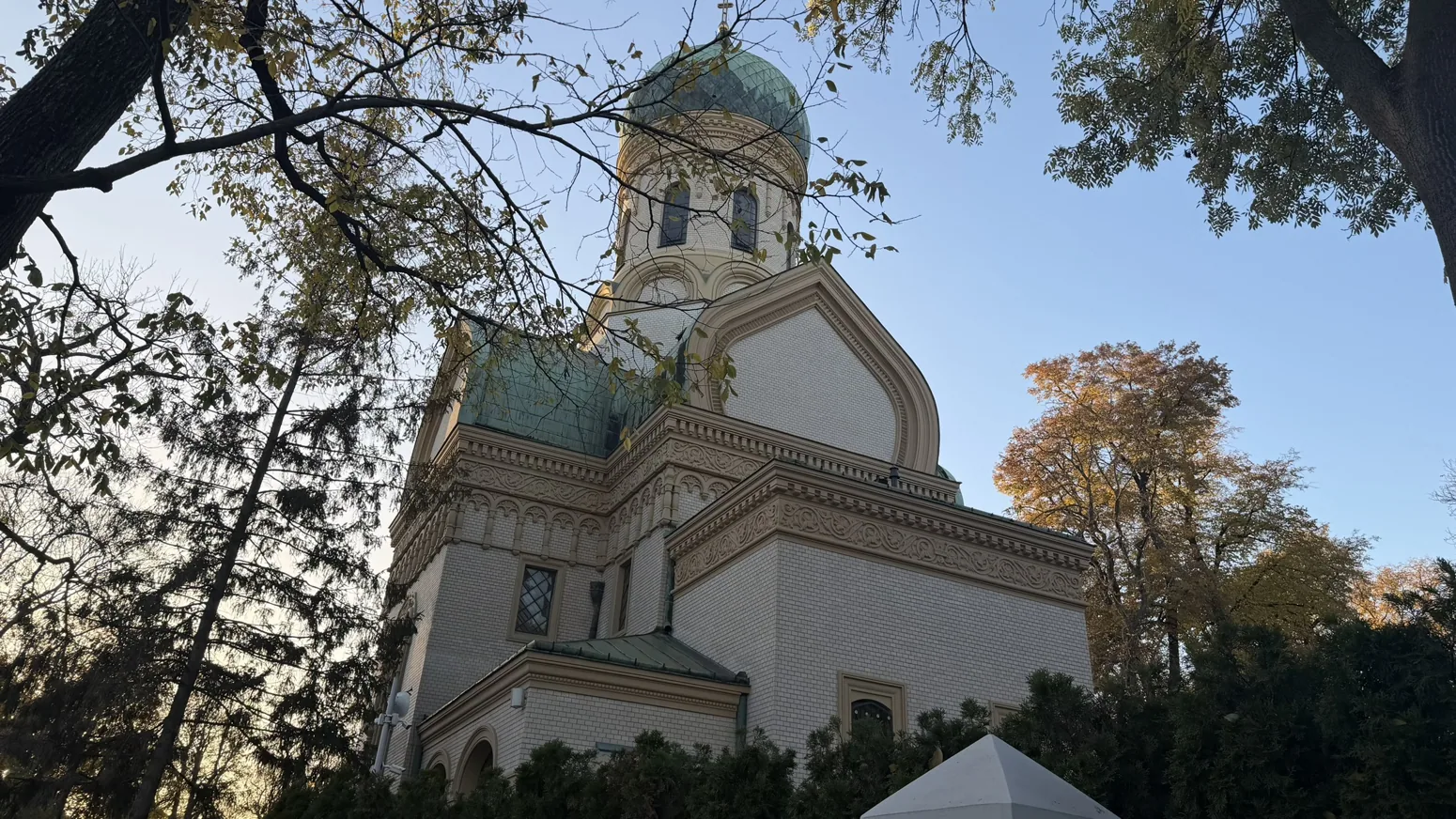
The Church of St John Climacus (Cerkiew św. Jana Klimaka) is the cemetery’s most recognisable landmark. Designed by Vladimir Pokrovsky, it was consecrated in 1905. The pale walls, green roof and golden dome make a striking contrast with the darker gravestones and autumn trees.
Its interior is also significant: the Polish painter and iconographer Jerzy Nowosielski worked on its polychrome decoration in the twentieth century. A visitor who only sees the exterior should not assume the building is an empty monument. This is a functioning Orthodox sacred space, and access to its interior depends on services and parish arrangements.
Crosses, inscriptions and the language of faith
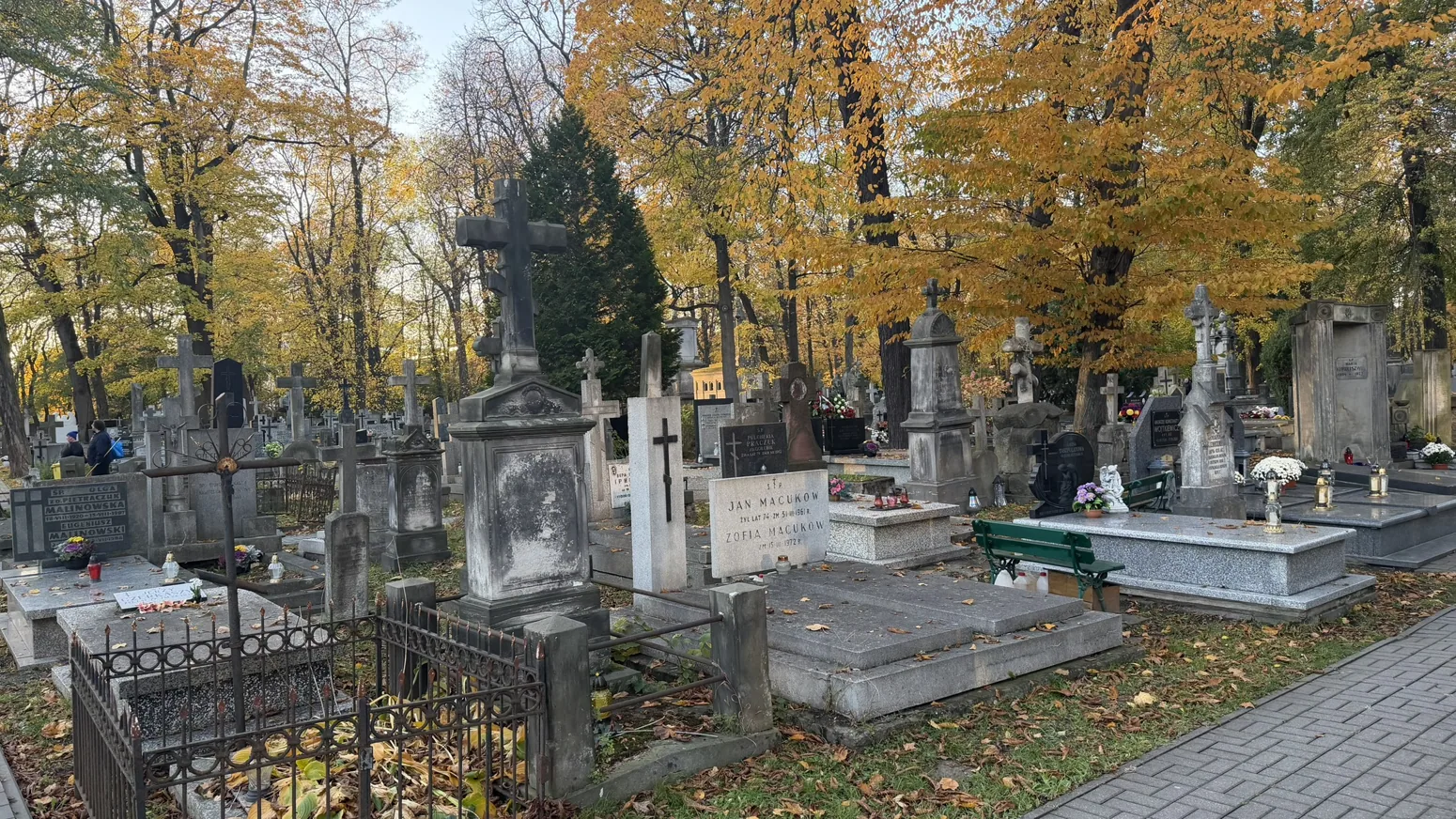
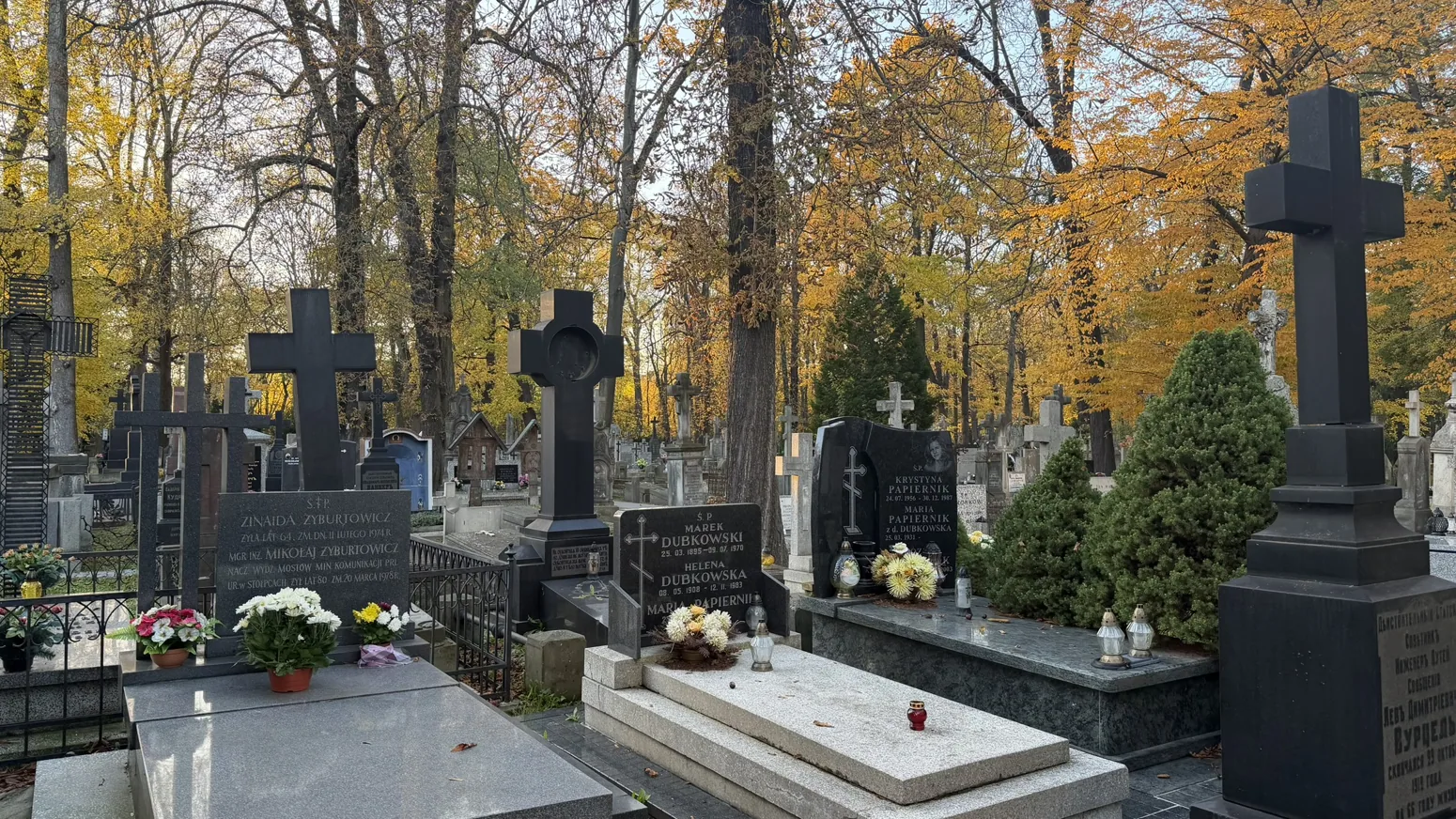
The cemetery rewards a slow walk. Some monuments use an Orthodox cross with multiple crossbars; others show familiar Christian symbols or forms influenced by European funerary architecture. Slavic-language inscriptions and Cyrillic lettering appear alongside Polish names, reflecting the variety of people connected with Orthodox Warsaw.
There is no single visual formula for an Orthodox grave. Different families and periods chose different monument styles, and one cannot reliably identify a person’s ethnicity or political allegiance from the appearance of a cross or the alphabet on a headstone. What the stones do reveal is a community maintaining religious continuity across enormous political changes.
Small chapels and striking memorials
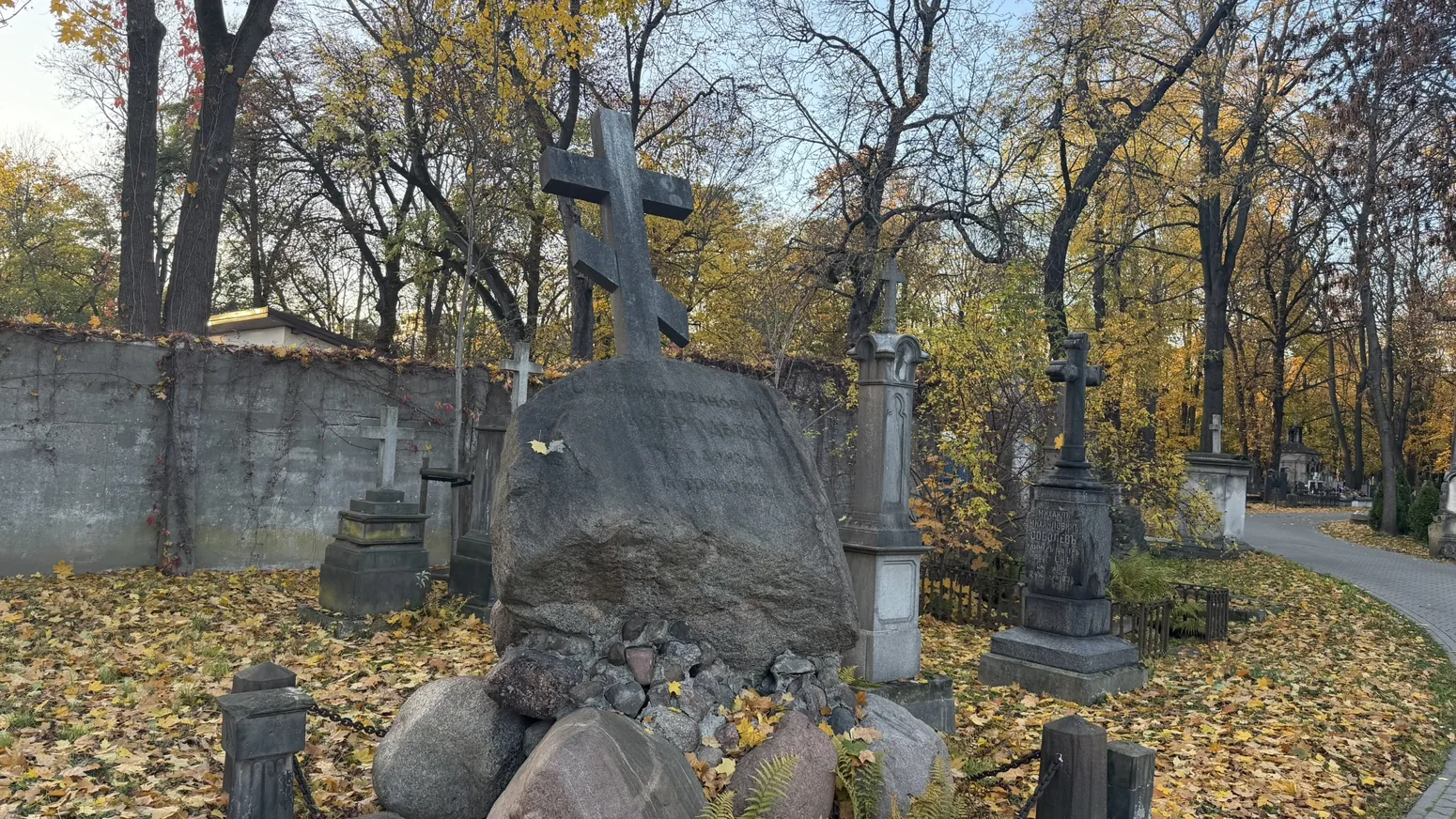
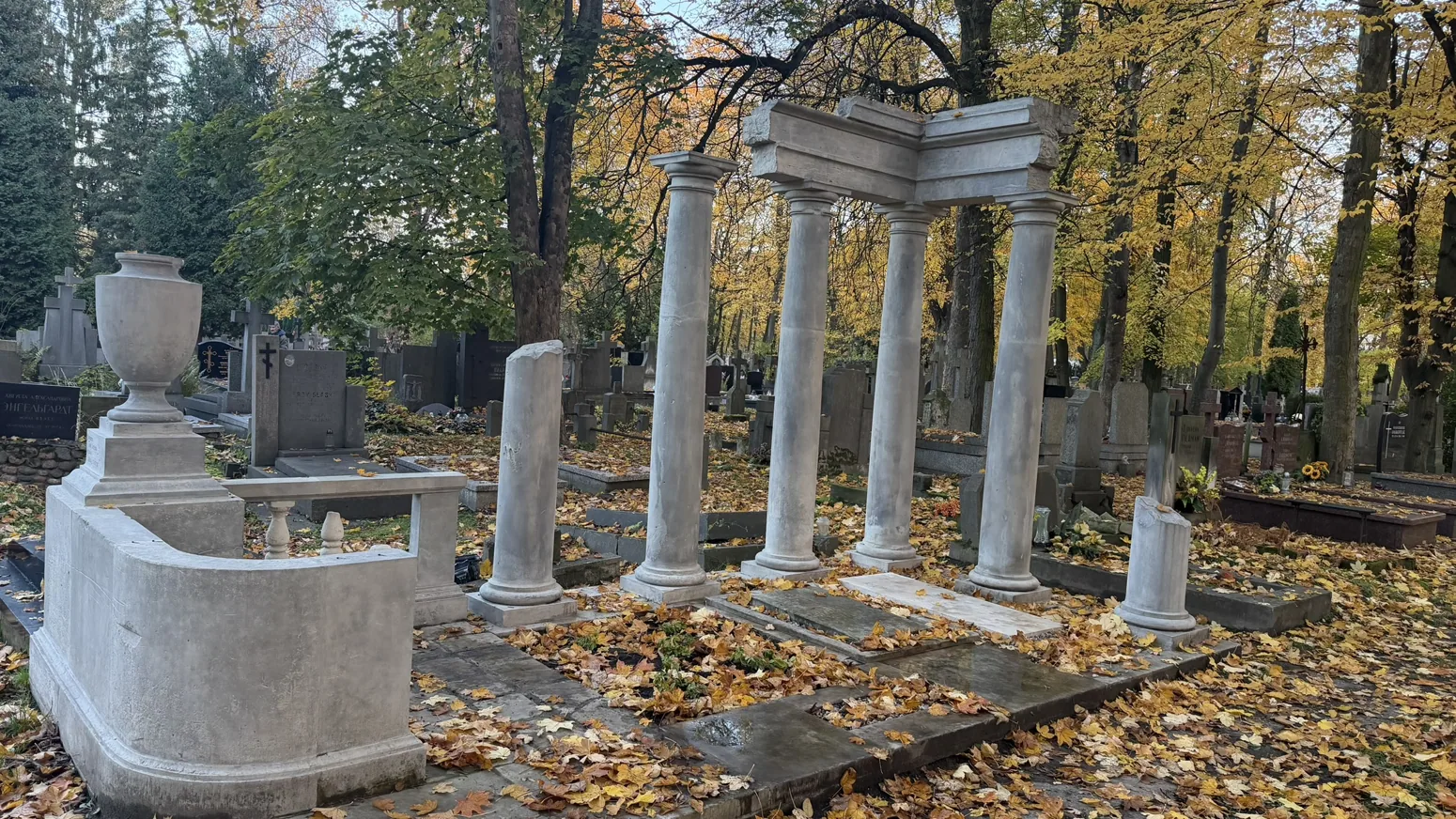
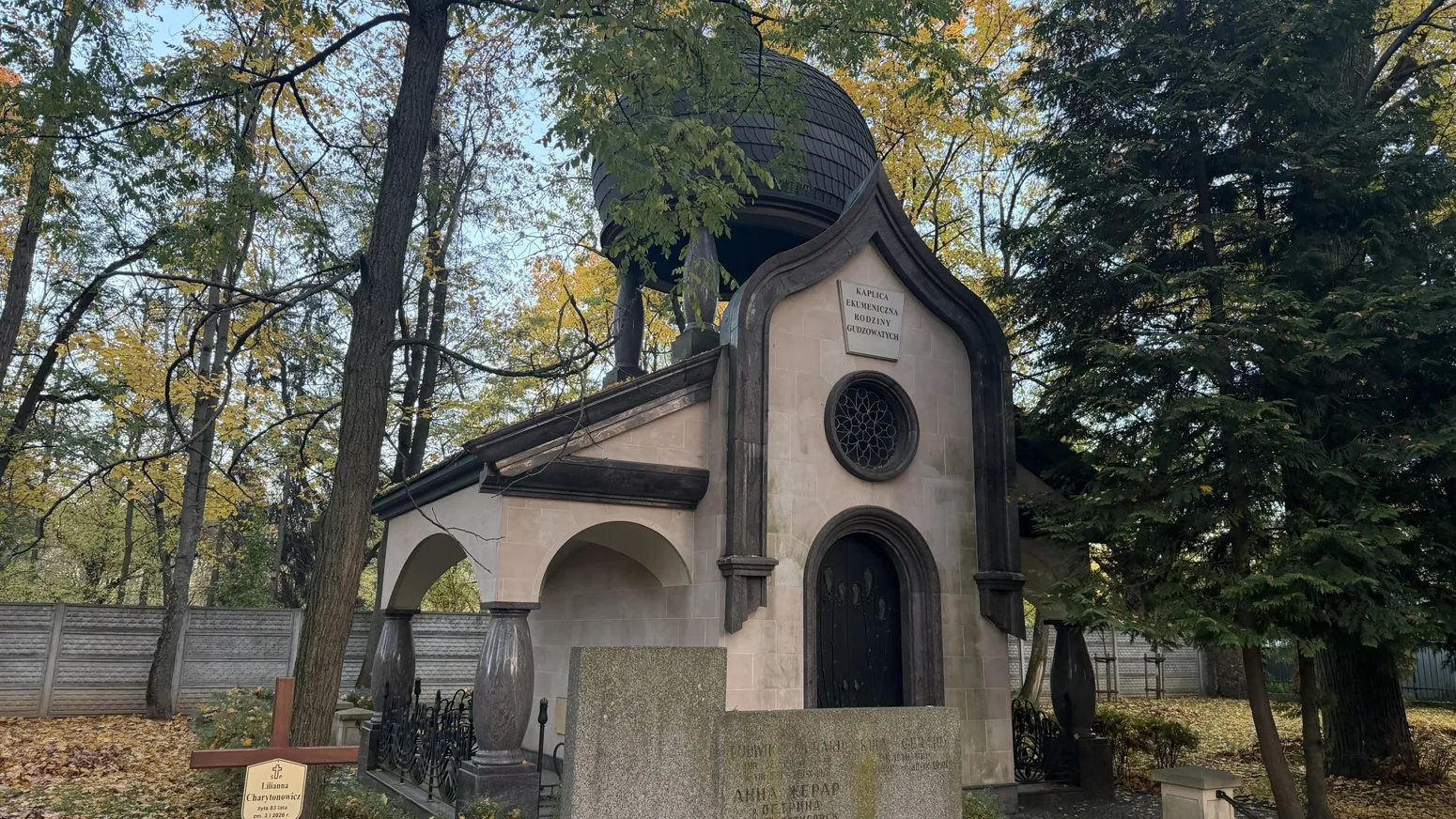
Beyond the church are smaller chapels and monuments, some restrained, others ornate. Carved columns, enclosed family plots and stonework softened by autumn leaves give the cemetery its atmosphere. These were not merely decorative choices: architecture could express faith, family identity and the wish to be remembered.
The photographs here show structures that stood out on our visit. Without a readable inscription or independent grave-register confirmation, it would be misleading to attach a famous name to a particular monument. The forms themselves deserve attention, even when the individual stories are still to be researched.
A Russian-appointed mayor and an Orthodox Warsaw
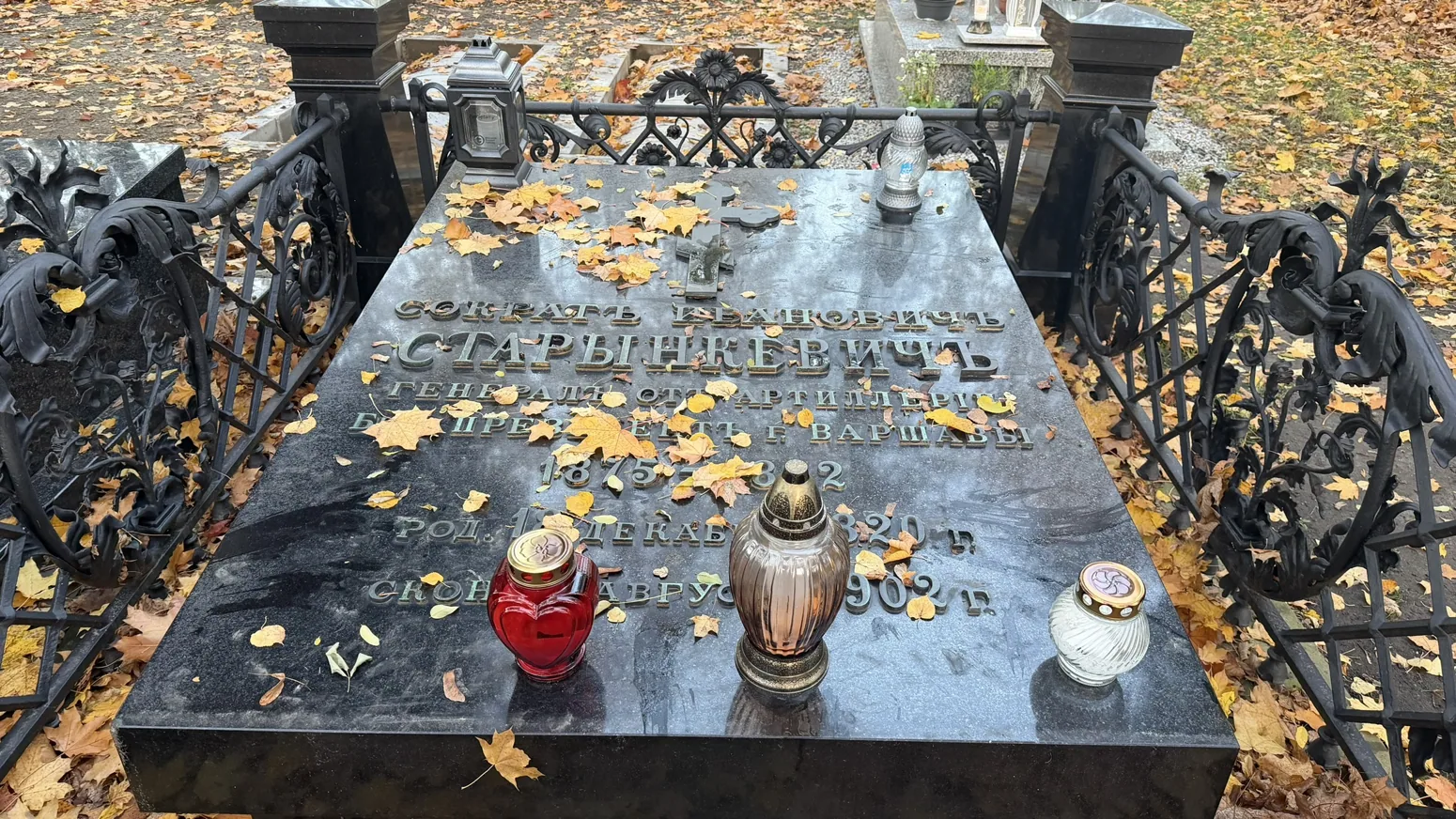
Among the notable people buried here is Sokrates Starynkiewicz, the Russian-appointed president of Warsaw whose work on the city’s water and sewerage system left a profound civic legacy. His burial illustrates the complicated position of people who served within imperial structures while making lasting contributions to the Polish capital.
Other burials include the writer Mikhail Artsybashev and theologian Fr Jerzy Klinger. Their careers point in different directions — literature, faith, intellectual life — reminding us that this cemetery is a record of a community, not simply a military or political site. The photographed individual memorials below are not presented as those graves without confirmation.
Violence reached the parish gates
The cemetery’s story is also part of the tragedy of August 1944. During the German assault on Wola, Orthodox clergy, members of their families and children connected with the parish orphanage were murdered. The victims were part of the broader civilian catastrophe remembered through our Wola guide and the Warsaw Insurgents Cemetery.
Warsaw’s post-war population changed dramatically, but the cemetery continued to hold a place for the Orthodox faithful. Its ongoing maintenance and worship are as much part of its history as the more distant stories of the partitions and wartime destruction.
Beyond the well-known routes
Location: Cmentarz Prawosławny, ul. Wolska 138/140, Wola, Warsaw. St John Climacus stands within the cemetery grounds, close to other historic religious and burial sites in Wola.
Allow time simply to walk, read and observe. This is an active cemetery, so keep to the paths, avoid disturbing graves or private ceremonies, and follow any current parish notices. Opening arrangements and church access can change; check with the Orthodox parish before planning an interior visit.
For a wider picture of Warsaw’s diversity, continue with our Cemeteries & Memorials hub, where this site sits alongside the Protestant, Jewish, Muslim and Karaite cemeteries.
Another layer of the city
The Orthodox Cemetery is a reminder that Warsaw’s past was never one faith or one language. The same streets that witnessed political upheaval also carried the ordinary rhythm of worship, burial and remembrance. That story survives here, in stone and in a living parish.
Return to the cemeteries hub or continue exploring Wola.