
An image with more than one origin
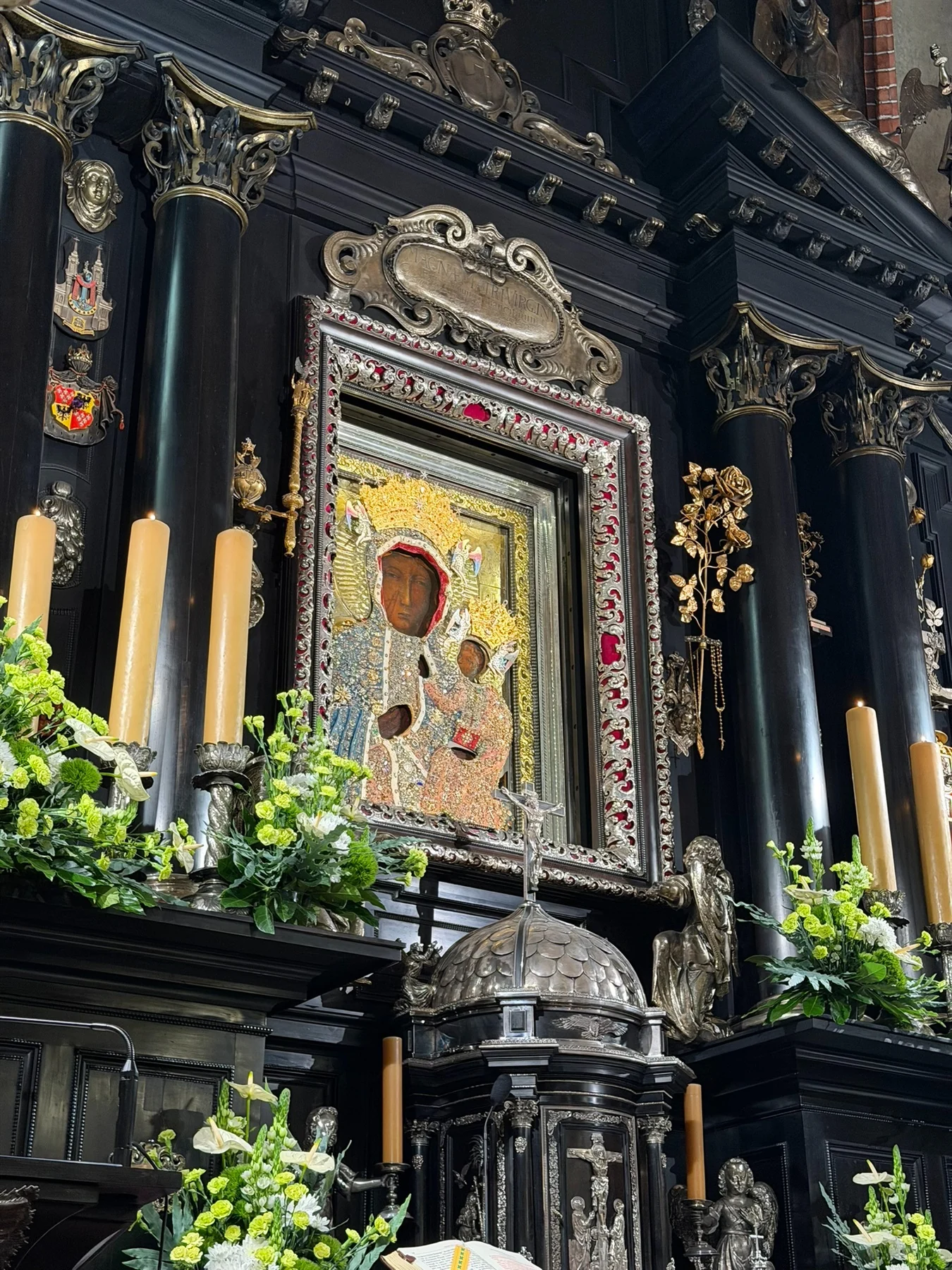
The Black Madonna is not an apparition story. At its centre is a painted image of Mary and the Christ Child, honoured at the Pauline monastery of Jasna Góra. The monks settled in Częstochowa in 1382 under the patronage of Duke Władysław of Opole. An early narrative, the Translatio tabulae, traces the panel through Jerusalem, Constantinople and Bełz. That is a medieval account of its supposed journey, not a proven chain of custody.
A much-loved tradition credits Saint Luke with painting the image on a table from the Holy Family’s home. Art historians dispute the panel’s date and origin; the legend is best appreciated as part of its devotional history, not as an established attribution.
The attack of 1430
In Easter 1430, raiders attacked Jasna Góra and damaged the revered painting. This is the first great rupture in the image’s documented history. The icon was subsequently restored in Kraków, under King Władysław Jagiełło, and substantially repainted. The wounds visible on Mary’s cheek became defining visual features of the Black Madonna.
The attackers are frequently called “Hussites” in popular accounts, but their precise identification is more complicated. “Raiders” is the safer description without specific documentary support.
A monastery under siege
In 1655, during the Swedish invasion known as the Deluge, the monastery defended itself against a Swedish siege. Military resistance was a historical event; the belief that Mary protected the defenders was a religious interpretation embraced and amplified in later retellings. The victory gave Jasna Góra an enduring role in Polish collective memory.
On 1 April 1656, King John II Casimir made the Lwów Oaths, placing the kingdom under Mary’s protection as Queen of Poland. These linked acts of war, royal ceremony and devotion made the icon much more than an object inside a chapel.
What is original?
Even the apparently simple question “how old is the painting?” has no uncontested answer. Because the work was extensively restored after 1430, most of the visible painted surface belongs to the fifteenth century. Interpretations of the underlying panel differ. That uncertainty is part of the historical story, not a flaw we need to disguise.
The image was crowned with papal crowns in 1717 and remained central to Polish Catholic identity through the partitions and communist era. Traditions also connected it to events such as the Polish victory of 1920, but these claims should be presented as acts of faith and memory.
Visiting the story today
At Jasna Góra, the icon is venerated in its chapel and revealed according to a daily ceremonial schedule. The complex is a working pilgrimage site as well as a major historic monument. A visitor can appreciate the six centuries of Polish history attached to the image without having to accept every supernatural claim made about it.
We will connect this article to the Sacred Places directory, the relevant regional guide and future historical articles on the Deluge and Poland’s national symbols.