
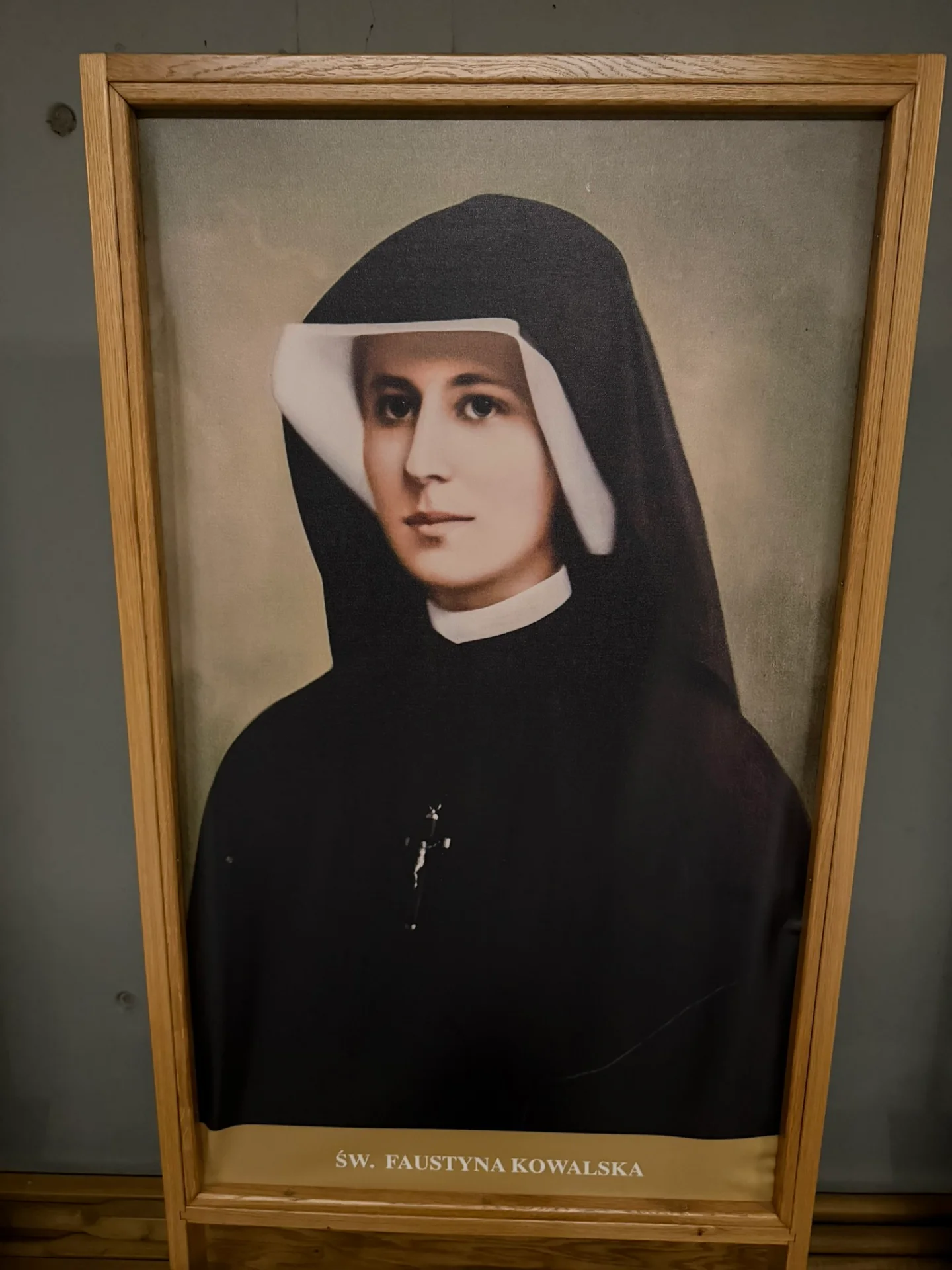
A vision in Płock
Helena Kowalska, born in 1905, entered the Congregation of the Sisters of Our Lady of Mercy in Warsaw in 1925 and took the name Faustina. Her work in convent communities was often ordinary: cooking, gardening and serving as a porter. On 22 February 1931, in Płock, she reported seeing Christ with pale and red rays emerging from his heart, asking her to commission an image with the words “Jesus, I trust in You.”
The vision is known from her own religious testimony. Whether it was supernatural is a question of faith, not something independently settled by a historical document. But the subsequent painting, writings and public response are matters that can be traced.
From diary to image
At the encouragement of her confessor, Father Michał Sopoćko, Faustina recorded her experiences in notebooks between 1934 and 1938. Her Diary recounts requests for a Feast of Divine Mercy, a chaplet and particular forms of prayer. The first Divine Mercy painting was completed in Vilnius in 1934 by Eugeniusz Kazimirowski.
The image particularly familiar in Poland is not that first painting: Adolf Hyła produced a later version for the convent at Kraków-Łagiewniki. Faustina died there in 1938, aged thirty-three, from tuberculosis. The place that witnessed her final years became central to the devotion’s later history.
The years of prohibition
The story did not develop in a straight line from vision to international celebration. On 6 March 1959 the Holy Office restricted the circulation of the devotion in the forms advanced through Faustina’s writings and images. Later Catholic accounts place considerable weight on faulty translations, though commentators have raised broader theological concerns as well. The reasons should therefore not be reduced to a single uncontested explanation.
On 15 April 1978 the Congregation for the Doctrine of the Faith declared the earlier prohibition no longer binding. Cardinal Karol Wojtyła had supported renewed examination of Faustina’s life and legacy. This period of resistance and reassessment is not an awkward footnote: it shows the institutional history through which a private revelation can become a global devotion.
From Kraków to the wider world
As Pope John Paul II, Wojtyła beatified Faustina in 1993 and canonised her on 30 April 2000. Divine Mercy Sunday was established for the universal Catholic Church. The sanctuary at Kraków-Łagiewniki became an international pilgrimage centre, while the movement reached far beyond Poland.
Canonisation concerns the Church’s judgement of a person’s holiness. It does not amount to a declaration that every vision or statement in her Diary occurred supernaturally. Keeping that distinction clear allows both believers and curious visitors to understand the significance of the devotion.
Tracing the story across four cities
The reported 1931 encounter is associated with Płock; Warsaw preserves locations from her early religious life; Kraków-Łagiewniki contains her tomb and the well-known Hyła painting; and Vilnius, now in Lithuania, is where the first Divine Mercy image was painted. Together these places show how a profoundly Polish story also reaches across borders.