A princess and a kingdom of salt
Long before Wieliczka became a famous stop on travellers’ itineraries, salt was one of the most valuable resources a ruler could control. It preserved food, supported trade and generated income. In the thirteenth century, bringing reliable supplies of rock salt to the lands of southern Poland mattered enormously.
Kinga, a Hungarian princess who married Bolesław V the Chaste, became one of the most beloved figures of medieval Poland. She was later remembered as a generous patron and religious foundress — and, in popular tradition, as the woman who brought salt to her adopted homeland.
The ring left behind
The legend begins in Hungary. As Kinga prepared to leave for Poland, she was offered valuable gifts. Instead, so the tale says, she asked for something that could benefit her new people: salt. At a Hungarian salt mine she cast her ring into a shaft, a gesture that seemed to leave the jewel lost forever.
The versions differ in detail. Some place the moment at a particular mine, while others tell it simply as part of Kinga’s farewell to Hungary. This is an inherited legend, not an eyewitness record of her journey.
A discovery in Polish earth
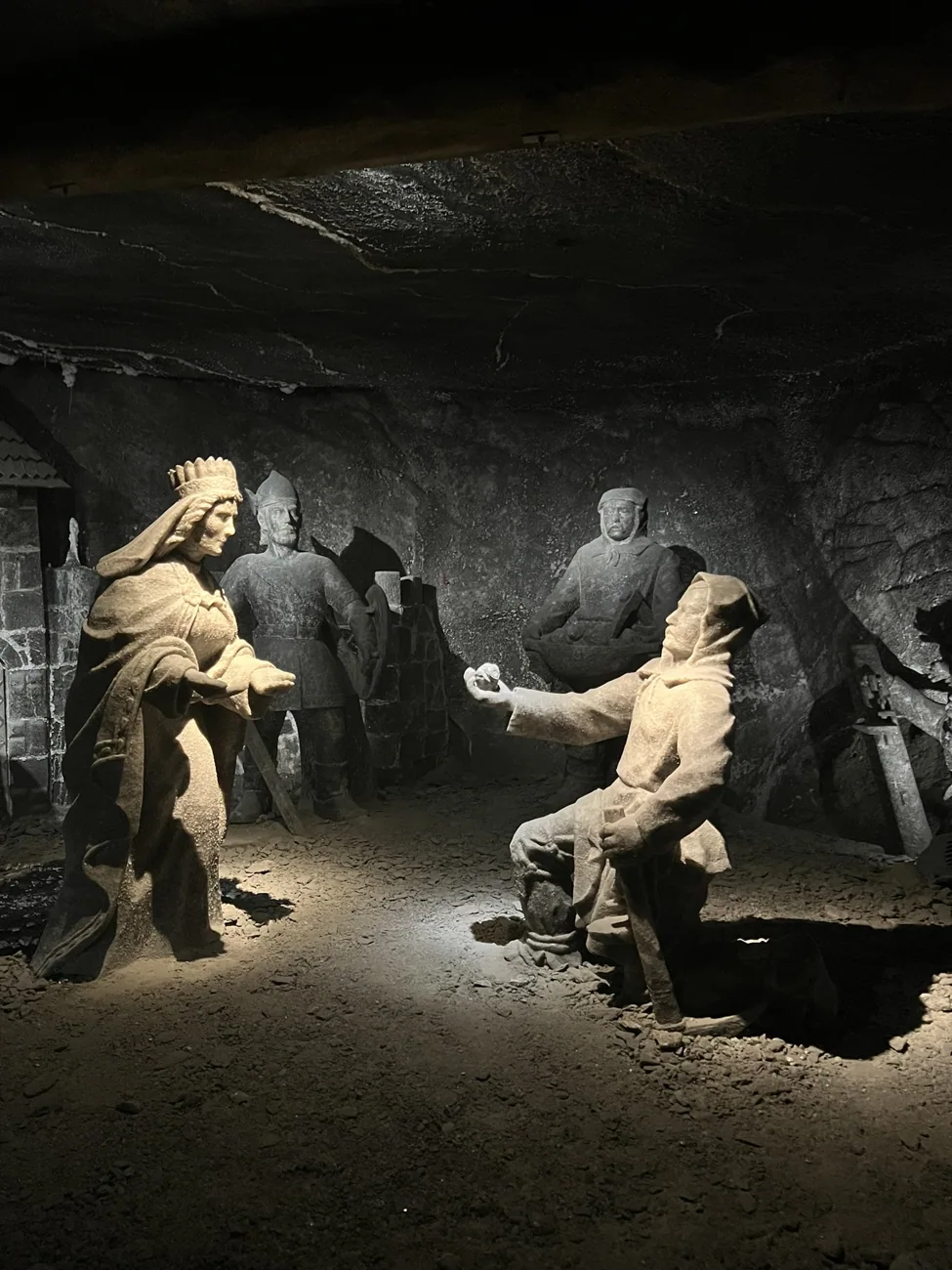
After Kinga reached Poland, workers digging for salt are said to have struck an unexpected deposit. When they split open a block, they found the very ring she had thrown away. The jewel had travelled, impossibly, from Hungary into Polish rock — the sign that the gift of salt had arrived with its princess.
Bochnia is especially important to the story: major rock-salt deposits were discovered there in the mid-thirteenth century, during Kinga’s lifetime. Wieliczka shares the tradition and remains strongly associated with the saint. Neither mine should be presented as proof that the ring was literally found.
The real Kinga behind the legend
Kinga’s historical life needs no miracle to be significant. She belonged to the Hungarian Árpád dynasty, married into the Piast ruling family and is remembered for religious patronage, charity and her role in Stary Sącz, where she founded a Poor Clare convent after being widowed.
The legend connects that historical woman to an economic transformation: the rise of Poland’s royal salt mines. It offers an elegant explanation for a resource that helped shape the region, turning mining history into a story of a queen’s care for her people. Kinga was canonised in 1999.
The story carved into Wieliczka
The legend lives not only in words. In the Wieliczka Salt Mine, sculptural scenes commemorate Kinga and the discovery of her ring. Our own photograph shows a crowned woman receiving a small object from a kneeling miner, surrounded by figures carved in the salt-rock setting.
It is a depiction of what the legend means to generations of miners and visitors, not evidence that the extraordinary event occurred. The best way to encounter it is as both a work of devotional storytelling and a reminder of the deep connection between the salt mines, the region and its patron saint.